Staying in Ho Chi Minh City District 4 : Tips for Air Bnb Guests

Let’s face it, during your first tip to Saigon, You don’t know anything about the different districts of Ho Chi Minh City. Now it’s up to you to pick the best spot for your family to stay during your vacation to Ho Chi Minh City! The pressure is on! I’m gonna give you some information about District 4 compared to District 1 to help you make a decision if an Air Bnb in District 4 is a good option for your family.

How does Ho Chi Minh City’s District 4 compare to District 1? They are very different but District 4 is so close to District 1 that it makes sense to stay here if you are travelling. I’m going to go over some of the questions you might have if you choose to stay in District 4 rather than District 1.

Should I stay in D4 instead of D1?

This all depends on what you are looking for. In my opinion, if you are planning to spend most of your time outside of your hotel, I would have no problem staying at one of the accommodation options in District 4. It is an easy hop in a taxi cab to get right into the thick of things in the middle of District 1.

If you are looking for an apartment style stay that has a swimming pool, the accommodation options in D4 are pretty sound. The location is good if you are okay with jumping in a taxi cab ride when you want to go out. If you decide to walk around, you’ll be in for a real experience of a local area of Ho Chi Minh City. Honestly, this isn’t the right location to stay in if you want to leave your hotel and walk right outside to find a restaurant that is suitable for younger kids or western food.

District 4 Information

Over Thirty years ago, district 4 was often known for its low level of security and gangsters. However, thanks to improving management by government and gentrification, today District 4 is a pleasant place. It hasn’t been known as a dangerous area since the 70’s.

Due to its location, District 4 has become a coveted area for people to live and work. This makes the property value for homes in District 4 extremely high. Many of the families who still live in this district now have been living in these houses for decades. The small houses that we refer to as tube houses because of their narrow width but tall height are tightly packed in, creating a web of small alleyways that are very interesting.

In recent years, due to the influence of other nearby districts like District 1 and District 2, District 4 has gradually developed. Many new apartments were built here, streets were improved and repaired, entertainment areas also began to appear. This not only makes local people’s lives better but also creates convenience and comfort for tourists when visiting District 4.

District 4 Location Compared to District 1

District 4 is likened to a triangular island located in the heart of Ho Chi Minh City. It is surrounded by rivers and canals and stuck among 3 other developed districts: District 1 (in the Northwest), District 7 (in the Northeast) and District 2 (in the South).
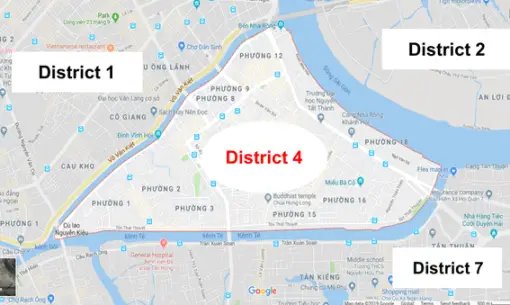
Map of District 4 and surrounding area


This means that District 4 is very close to District 1, people here usually only take 10 minutes to reach famous places in District 1. To get to District 1 from District 4, you need to cross a Ben Nghe canal. There are 5 bridges built to cross this canal such as Khanh Hoi bridge, Calmette bridge, Ong Lanh bridge, Rainbow bridge, and Nguyen Van Cu bridge. Depending on your location, you can choose the closest bridge to shorten the time to reach District 1.
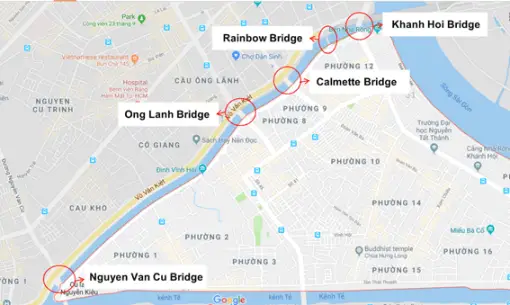
District 4 Bridges connecting to District 1


Hotels or Airbnb?

Honestly, District 4 doesn’t have many hotels like District 1. So sometimes on holiday, hotels in District 4 often run out of rooms. Therefore, if you want to stay at a hotel to enjoy high-class service, you should book a room advanced.

Although not owning many famous hotels like District 1, however, District 4 has a lot of room rental services which local people open by themselves. To be able to find out more information about these rental rooms, you can easily find it on Airbnb’s website.

Normally, both hotels and room rental services will be in the newly constructed apartments right across from the canal. This means you are very close to the center of the city for a bit cheaper price. The area to wander about from these large apartments is actually interesting. Just behind these large apartments you can wander into Xom Chieu market for a visit during the day to see one of the most local and busiest wet markets in Ho Chi Minh City.

If you decide to take a look at some hotels in town check out our article about Hotels for Value in Ho Chi Minh City.

Transportation in District 4

District 1’s location for walking to some of the main attractions in Ho Chi Minh City is better than District 4. District 4 is about a 10-minute walk plus a bridge crossing in order to get to Nguyen Hue walking street in the center of the city. The walk might be a little bit difficult but interesting. While walking across these bridges, you can watch the canal flowing through the city and take some nice photos. The bridges at night will shine by the beautiful street lights, which is one of the typical beauties of this city.

If you are going for a night out and a bit dressed up, you’ll probably want to call a taxi or grab to give you a lift. I don’t think District 4’s location is convenient for making a lot of trips back and forth to the city center on foot but its very close if you are using a taxi cab. Check out our in depth article about about taxi cabs in Ho Chi Minh City to

Another thing about transportation in District 4 you should know is heavy traffic jams at rush hour. Because the roads in District 4 are quite small and narrow, so during peak hours these roads often occur more serious traffic jams than other districts. My university is located in District 4, every afternoon after school, it takes me about 45 minutes to 1 hour to get home. If you choose to use a taxi or grab to take you around, don’t choose rush hours to go out.

Walking around District 4

If district 1 is famous for high-class and luxury restaurants, the cuisine of district 4 is famous for being found in plenty with delicious options. There are so many people living, working, and visiting District 4 that the local street food is fantastic and famous. You can find street foods in food carts, food stalls or small private restaurants open by locals.  Food stalls and restaurants are usually located along many streets in District 4, which makes district 4 is so famous for many food streets. The three most famous food streets that I want to recommend to you are Xom Chieu, Vinh Khanh and Ton Dan.

Xom Chieu has special and delicious dishes. The food stalls and restaurants in this street have existed for a long time and have created a famous reputation. That makes them attract many people coming and trying the taste of special foods. These dishes which are cooked with unique recipes seem to be “specialties” of this district. Some “specialties” on Xom Chieu street I want you to know are banana cooked with sugar, crab soup mixed vegetables and many other types of ingredients, mussel noodles.

– Pha Lau Miss Oanh

Beef Organs Cooked in Coconut Milk served with Banh MI

Address: C200 / 20 Xom Chieu, District 4

– Vermicelli crab and snail

Address: C200 / 6 Xom Chieu, District 4

– Oc To

Small but Popular Seafood Stand

Address: C218 Xom Chieu, District 4

– Crab Soup Hang

Thick Soup made with Tapioca, Crab, Shrimp, and about 8 other ingredients

Address: C200 / 18 Xom Chieu, District 4

– Banana cooked with Sugar

Braised with sugar and topped with sesame seeds, this dish is unique to Xom Chieu

Address: Head of the alley 200 Xom Chieu, District 4

In 2018, Vinh Khanh street officially became the food street of District 4 and is strictly managed on food safety and hygiene by the government. Up to now, it has been extremely famous not only to locals but also for foreign visitors. Most of the restaurants here serve seafood and beer. Plates of seafood here are cooked in Vietnamese-style but a little bit spicier than normal Vietnamese food. Famous dishes like snails cooked with coconut milk, fried crab with salt and chili, grilled octopus with sate can be found up and down Vinh Khanh Street. If you are a person who loves seafood, Vinh Khanh is definitely a great choice for you. The operating hours of Vinh Khanh street are from afternoon to evening. The restaurants here are crowded at 6:00 pm until Midnight. Make sure that you are there at the right time so you can enjoy the bustling atmosphere of this food street and delicious dishes. If you want to experience street food like this but are a bit nervous to do it yourself,

– Chilli hotpot

Alot of grilled meat options, oysters, and hotpot. Delcious and Highly recommended

Address: 232 Vinh Khanh, District 4

– Oc Oanh

A standout on a street known for seafood, don’t miss out on the scallops!

Address: 534 Vinh Khanh, District 4

– Sushi Ko

International Sushi on the Street?

Address: 122/37/15 Vinh Khanh, District 4

In addition, other roads like Hoang Dieu, Doan Van Bo, Ngo Van So or Nguyen Truong To also have a few interesting restaurants. These roads are very close to Vinh Khanh and Ton Dan, you can visit them conveniently.

– Mi Vit Tiem Thuan Hieu

Chinese inspired Duck soup with wheat Noodles. Very Tasty and Open late

Address: 3 Hoang Dieu, District 4

– Crab Curry in Quan Oc 63

Crab smothered in Delcious curry sauce that you mop up with Vietnamse Bread. Very close to Air BnB’s on Ben Van Do

Address: 63 Nguyen Truong To, District 4

Any other recommendations?

Yeah, I’m gonna let you now about my secret coffee shop that is my absolute favorite This is my place for working during the afternoon. This is located 2-5 minutes from the Air BnB locations in District 4.

Spotlight Coffee 

Address: 64 Le Quoc Hung, Ward 12, District 4, Ho Chi Minh City

The operating hours: 7:00 am – 9:00 pm

We hope these tips help you make a decision on staying in District 4 or not. If so, please enjoy our recommendations for spending time in District 4 and commuting to District 1. Please share this article if you think it will help other travelers like yourself book a vacation that they will remember for a lifetime.

Post Source Here: Staying in Ho Chi Minh City District 4 : Tips for Air Bnb Guests
How to Call a Taxi in Vietnam?

A Simple Guide for Taxi-hailing in Viet Nam

Taking a Taxi has never been a budget-friendly option for traveling around. The situation is the same in Viet Nam. However, it turns out to be a decent choice in Vietnam where the condition of the public transportation system is troublesome even in major cities. If you prefer walking to taking a vehicle, you may want to think again. The hot and humid atmosphere combined with the hustle and bustle of Viet Nam will tire you down.


If this is your first time visiting Viet Nam, there is a big chance that you have many questions about taxi services. You may not know how to appropriately hail a taxi and wonder if the cab you are trying to catch is licensed. You are afraid of being ripped off. You want to know if it’s possible to pay for your ride by credit/debit card. So, let us show you everything you need to know about calling a taxi in Viet Nam, especially in major cities.


We only recommend Mai Linh Taxi and Vinasun Taxi for foreigners in Viet Nam. If you have any doubt about traditional taxi services in Viet Nam, it may be a good idea to use ride-hailing apps such as Grab or GoViet.

How to Identify a Licensed Taxi?

Unlike some other places around the world, for example in New York where taxis are either yellow or green, there are many brands operating cab services in Viet Nam. Hence, there are more than just one or two uniform colors for taxis.

If the taxi you are ordering is not licensed, which means it’s illegal and unregulated by local laws, you can easily get ripped off. The authorities might not be able to help you in these scenarios.

According to laws applied to transportation service vehicles, these are the things you need to notice before getting on any taxi in Viet Nam to avoid falling into dangerous situations:

– Brand name, operating phone number, and logo of the taxi service provider on both sides of the car.

– A price chart, a working meter connected to a receipt printer, and a taxi driver’s name card on prominent display inside of the vehicle.

– An authorized taxi emblem stuck to the windshield.

– A light box that says “TAXI” standing on top of the car.

How to Know if a Taxi on the Street is Available?

If there is no passenger in the taxi between 6 PM to 6 AM, the driver is obligated to turn the lightbox on top of his vehicle on. If the light inside a cab is on, it’s available. You can feel free to hail them.

It might be frustrating to hail a taxi that looks “available” just to watch it pass by instead of stopping and picking you up. Perhaps the street is too crowded that the driver cannot turn the car towards you or they forgot to turn off the light. Please be patient and don’t get mad because it won’t happen regularly.

How to Order a Taxi in Viet Nam?

If you see an available licensed taxi on the street and want to hail it, feel free to do so since there is no specific spot for cab standing in Viet Nam. We know that hailing a taxi in the streets of Viet Nam doesn’t always bring about your desired result. Ordering one from their operators via phone might be a better option.

If you are staying in a motel, hotel or resort, ask the receptionist to order a taxi if you need one. They definitely can help overcome any language barrier.

If you want to order a taxi via phone by yourself, here is a list of the numbers of two trustworthy service providers in famous tourist cities and provinces of Viet Nam:

CITY/PROVINCE SERVICE PROVIDER PHONE NUMBER FARE (10% VAT INCLUDED)
Sapa (Lao Cai) Mai Linh Taxi 1055 (national)

(0214) 376 76 76

(0214) 370 70 70

Up to 20.600VND/km
Ha Noi Mai Linh Taxi 1055 (national)

(024) 38 333 333 (024) 38 222 666 (024) 38 222 555 (024) 38 616 161

Up to 20.600VND/km
Hoi An Mai Linh Taxi 1055 (national)

(0510) 3 92 92 92

Up to 20.600VND/km
Vinasun (0511) 3 68 68 68 Up to 16.500VND/km
Da Nang Mai Linh Taxi 1055 (national)

(0236) 3 56 56 56

Up to 20.600VND/km
Vinasun (0236) 3 68 68 68 Up to 16.500VND/km
Hue Mai Linh Taxi 1055 (national)

(0234) 3 89 89 89

(0234) 3 82 47 47

Up to 20.600VND/km
Nha Trang Mai Linh Taxi 1055 (national)

(0258) 38 38 38 38

Up to 20.600VND/km
Vinasun (0258) 38 27 27 27 Up to 16.500VND/km
Da Lat Mai Linh Taxi 1055 (national)

(0263) 38 38 38 38

Up to 20.600VND/km
Ho Chi Minh City Mai Linh Taxi 1055 (national)

(028) 38 38 38 38

Up to 20.600VND/km
Vinasun (028) 38 27 27 27 Up to 16.000VND/km
Can Tho Mai Linh Taxi 1055 (national)

(0292) 3 65 65 65

Up to 20.600VND/km
Vinasun (0292) 38 27 27 27 Up to 16.500VND/km

The meter begins counting when the taxi picks you up. There is a fare called “open-door-fare”. It is set approximately from 8.000VND to 15.000VND depends on the service provider and model of the car. The further your distance is, the cheaper fare-per-kilometer you have to pay. For example, Vinasun’s open-door-fare for a 5-seated Toyota Vios is 11.000VND. Then, you are charged 14.500VND/km for the first 30 kilometers, and 11.600VND/km from the 31st kilometer and beyond. There is always a price chart inside every taxi showing detailed information and fare.

There is no Uber or Lyft in Viet Nam. Instead, there are several similar ridesharing and ride service hailing networks such as Grab or GoViet for you to choose in your personal preference. They have foreseeable service fare as well as emergency reporting features thus the rides are more reasonable and safer.

How can you Pay for a Cab Ride in Viet Nam?

Drivers usually prefer cash. You can pay for your ride with credit/debit cards as well. Tipping is not a familiar manner in Viet Nam, but you can consider doing that if your trip is excellent. Drivers sometimes expect not to give back your change if it’s a small amount. If you feel irritated about it, tell them immediately.

Always Remember to Stay Aware

Before getting on any taxi, remember the number on the license plate, the taxi number glued on the windshield, or the driver’s name. If possible, take note of that information in case something dangerous happens. If you have a terrible ride or accidentally forget your belongings in the cab, providing that information to the operators can help solve your problems quickly.

You can’t fully trust registered drivers since some of them might try to rip you off by going on a detour. You could always open up Google Maps to make sure your driver isn’t taking you the long way.

Taking a Taxi is almost never going to be the most budget-friendly option. If budget isn’t your primary concern, taking a cab surely is easier and more comfortable than waiting for a bus or walking under the scorching sun. Also Taxi’s in Vietnam are most likely a lot cheaper than what you can find in other countries. We hope this article has helped you answer any questions you might have about how to call a taxi in Vietnam.

Post Source Here: How to Call a Taxi in Vietnam?

Spending Christmas in Saigon, Vietnam

Christmas is nearly a month away, and can be trully a magical time in Vietnam (minus the snow). If you decided to spend our favorite holiday in the South of Vietnam, make sure to check out our video on what Xmas is really like like in Saigon!

Are you spending Christmas in Vietnam? What are you going to do ?

If you are interested in then be sure to check out our, if you are looking to check out a specific area of Ho Chi Minh City then ask about our private tours!

Post Source Here: Spending Christmas in Saigon, Vietnam

Exploring Ho Chi Minh City

Back in May, Our team and I had the chance to go on a custom History tour with a man from the UK named Tim Doling. Tim’s knowledge of Historic Vietnam may be unparalleled by any foreigner living in Vietnam. Researching into some of the most historical figures, architecture, railways, and history of Vietnam, Tim will blow you away on his Historic Walking Tour of Ho Chi Minh City or Cho Lon.


When meeting with Tim, we had the chance to sit down over coffee and discuss the details of Historic Vietnam starting around the 1600’s into the 1950’s with the exit of the French from Vietnam.


This chance to jump into your imagination and experience Saigon in the past is one that has stuck with me since. It has changed the way I even drive down the street. Now my eyes are constantly darting to the sides looking for old architecture that I might have driven by thousands of times before but never realized.


This has also led to a major shift into our City Tours here at Back of the Bike Tours. Armed with new knowledge from an excellent Historian we were able to adapt some of the things we learned working with Tim Doling to help us create what we feel must be the best City Tour on a motorbike in Ho Chi Minh City.


Tim has actually released a new book called “Exploring Ho Chi Minh City”. This book has 13 interesting walking tours for anyone who is interested in diving into the History and Architecture of old Ho Chi Minh City. If you are an expatriate living here in Ho Chi Minh City, please get up right now and go to the book store to purchase your copy.


You can also contact Tim to set up a walking history tour with him on his website at http://www.historicvietnam.com


As always, if you are interesting in experiencing the History and modern culture of Saigon you can check out our Morning City Tour all done with local, experienced, and professionally trained drivers.

Read More Here: Exploring Ho Chi Minh City

How to Take a Taxi in Ho Chi Minh City

Ho Chi Minh City is known for crazy traffic! There are viral videos and photos all over the internet that show the chaotic dance of traffic happening here everyday. Walking across the street in Ho Chi Minh City seems intimidating to some travelers. Never fear the taxi cab is here!

As a person who has been living in this city for years, I would recommend calling Mai Linh Taxi (028) 38 38 38 38, VinaSun Taxi (028) 38 27 27 27 , or booking via the Grab application. This post is a complete guide to traveling with taxis happily and safely in Ho Chi Minh City. I’ve crafted all you need to know about what brands to use and how to contact them.

What Taxi Brand should I ride with in Ho Chi Minh City?

When visiting Ho Chi Minh City, you should only ride in Mai Linh and Vinasun Taxi Cabs. They are the oldest and most trustworthy brands in Vietnam. If you are still nervous about riding a taxi cab there are alternatives digital brands for you to choose. Go with Grab or Goviet. These are popular brands here that are used daily.

Here are my useful tips for you to recognize these brands, how to book a taxi, how to reach customer service, and what to do if you lost something in your taxi. I’ll also guide you how to get a proper and trustworthy taxi when you first land in the airport.

Mai Linh

This taxi is hard to miss, it’s a distinct green color. The green color represents pure environment and brings some sense of comfort. This brand is familiar to not only local people but also many tourists as this brand can be found all over Vietnam.

Drivers of Mai Linh wear a white shirt, black trousers, and a green tie. These uniforms are really recognizable because of the green tie. If the taxi driver isn’t wearing this uniform, I would be suspicious and wait for a different cab.

Below we have listed all of the contact information for Mai Linh. It’s a good idea to keep their customer service number on your phone just in case you want to call them because of issues.

To Book a Taxi Call: (028) 38 38 38 38

The operators speak limited English. We recommend asking for the help of your hotel concierge or a friendly local if you need to call for a taxi.

Mai Linh’s Customer Service

Address: 64-68, Hai Ba Trung, Ben Nghe, District 1, Ho Chi Minh City, Vietnam

Hotline (Southern area of Vietnam): 028 3827 7979

Website:

Mai Linh does have an application but unfortunately there are too many errors making it not very useful. We recommend just grabbing a cab on the street or booking through the phone.

Vinasun

This is probably the most popular taxi cab in Vietnam. Their car is bare white with green and red lines connecting the wheels. The logo is a circle formed by red and green arrows, which reminds me of yin and yang symbol.

Similar to Mai Linh, the Vinasun taxi drivers’ uniform are white shirt, black trousers, and red tie. There is also a logo of Vinasun on the tie.

Phone number: (028) 38 27 27 27

This number speaks better English than Mai Linh. If you need to call on your own we recommend reaching out to Vinasun.

Contact of customer service departments:

Add: Vinasun Tower – 648, Nguyen Trai, Ward 11, District 5, Ho Chi Minh City, Vietnam

Tel:  (84-8) 38 277 178

Contact address when you lost your luggage: thatlachanhly@vinasuntaxi.com

When you want to complain about their staff: thaidophucvu@vinasuntaxi.com

When you have any other concern: contact@vinasuntaxi.com

Website:

These taxis are not only available in Ho Chi Minh City but also all cities in Vietnam. If you want to travel in Danang, Hanoi, or Hue City, remember the phone numbers and do those same steps.

Grab / Goviet

I may not have to tell you much about these brands. Grab is now the cheapest mode of transportation in Vietnam. Just download the app, install it on your phone. Then whenever you want a ride, open it and pick your means of transportation. You can choose your transportation between motorbike and car.

Older articles may say that Grab and Uber are two digital taxi brands in Vietnam, but you should take note that Uber has been shut down in this country since 2018. Moving into take the place of Uber, Goviet has become a popular ride app in Vietnam. Go Viet only has motorbikes at the moment, so if you have luggage, then stick to Grab.

How to get a taxi from Tan Son Nhat Airport in Ho Chi Minh City

There are two airports you can come in at in Ho Chi minh City. Getting a taxi from either airport is going to be very similar but a little bit different. We are going to direct you to make your way towards the “Taxi Queue”. At both airports you are going to need to make your way past the scammers and fake taxi’s looking to rip you off. These guys are gonna use the word “friend” alot and “looking for taxi”. Be strong but nice, and just keep moving away from them to find the queue.

At the international airport the queue should be across the little street when you exit from the terminals ground floor. The domestic airport you should make a left after exiting the terminal.

We only recommend two taxi services which we discuss in detail below. You are going to be looking for the representatives of these taxi companies so that you can get them to put you into the correct cab. The company’s colors is what you will be looking for to recognize their representative along with the brand logo.

Traveling from the Airport to the Center of Ho Chi Minh City

It takes around 30-40 minutes driving from Tan Son Nhat Airport to District 1, and even longer in rush hour. The cost for a taxi driving from Tan Son Nhat Airport to District 1 is around 100,000 VND to 200,000 VND (about 4.5 to 8.5 USD). Before leaving the airport, be sure to exchange some money as in Vietnam we only use our local currency.

How to Hail a Taxi in Ho Chi Minh City

Walking in Ho Chi Minh City is not popular, as the sidewalk infrastructure here is a mess. It can be an intimidating experience when you try to walk in this city. No worries, the taxis are here to help you get around.

Hail a taxi using our tips so that you travel safely in Ho Chi Minh City.

Lucky for everyone, there are usually taxi’s everywhere in Ho Chi Minh City. Specifically talking about the two brands we have mentioned above. It won’t take long to get a taxi if you stand on the street waving one down for a ride. The exception to this rule is during rain and rush hour. When hailing a taxi at these times, you can expect to wait if you don’t get lucky in the first few minutes.

Raise your hand to get the taxi driver’s attention. While they may understand your signal, you don’t have to yell “Taxi!” or whistle like in Western culture. If you can whistle loudly, I recommend you do that because you will just look cool.

When the taxi driver arrives, the next step is just telling them your destination.

Though drivers these days are trained to speak English, there are still elderly drivers who don’t. Thus, you’ll need to carry a phone with you to show them the address, or write down the address on a piece of paper. A screenshot of the location is also very helpful.

What do you do when lost your wallet/luggage/phone on the taxi?

First, contact the taxi customer service immediately and report what you’ve lost. Before calling, you should make sure that you can provide as much information as possible, including the taxi identification number, driver’s name, departure and arrival points, total fare, and the route that was taken.

If you forget your phone, you shouldn’t call your number. In case there are some drivers or passengers who may want to keep it for themselves. Instead, allow the operator to find the taxi you’ve taken and have it sent back to the office.

To conclude, traveling via taxis in Vietnam is easy. Follow these instructions, you have the best chance to enjoy your trip without being a victim of any fake taxis or scams. Just like in life, nothing is a guarantee but we believe that this advice will help every traveler in Vietnam.

Originally Published Here: How to Take a Taxi in Ho Chi Minh City

Do I Need A Visa For Vietnam?

Vietnams Visa Process

The Visa process has been adjusted last year in order to encourage more travelers and tourists to come to Vietnam.

This is great news for a lot of people but still not a perfect solution. With that being said, let’s talk about Vietnam Visa. who needs it? who doesn’t? how to get one?.

Requirements for everyone even if you don’t need a Vietnam Visa!?

A passport! This might seem crazy to some people to even mention this but some might not be used to traveling. So lets cover it, you MUST HAVE a passport if you are visiting Vietnam from another country.

This next point is very important and I have actually seen many people get caught up on this and not even realize it until they get here.

**important** Your passport must have 6 month of validity from the date of Travel. **important**

Our company Back of the Bike Tours have actually seen this issue a few times where one person in a group gets stopped from traveling because of this issue.

Don’t let it happen to you! Check cousin Jimmy and Grandma’s passport to make sure they aren’t expiring 6 months from the date you land in Vietnam.

This isn’t something you can get around as well, If you land in Vietnam with a passport that is expiring, they will not let you in. Your best and most unlikely scenario would be that your embassy would issue you an emergency passport to travel. The most likely thing to happen is that you will be on the next flight home after sitting in the airport for a number of hours.

Will I need a Vietnam Visa?

There are only 24 countries at the moment who are allowed to enter Vietnam without needing a Visa for a certain amount of time.

Exempt from Visa for 15 Day Stay:

Belarus

Denmark

Finland

France

Germany

Italy

Japan

Norway

Russia

South Korea

Spain
Sweden

United Kingdom


Exempt from Visa for 14 Day Stay:

Brunei

Myanmar


Exempt from Visa for 21 Day Stay:

Phillipines


Exempt from Visa for 30 Day Stay:

Thailand

Singapore

Malaysia

Laos

Kyrgyzstan

Indonesia

Cambodia

Exempt from Visa for 90 Day Stay:

Chile


My country doesn’t need a visa to visit Vietnam! How lucky is that?

Hey! That is pretty lucky as most countries do require a visa! Congrats and we hope you enjoy your vacation. Please make sure you don’t plan your trip longer than your visa exemption lasts and you will be golden! If you plan on staying longer than the amount of time you are exempt then please continue to read on and learn more.

My Country isn’t exempt from needing a Visa, Whats next?

That’s okay! Maybe your country will be exempt next year!

Let’s get you a Visa so that you can have fun traveling around this beautiful country.

There are three ways to get your Visa:

  1. Mail your Passport to the Vietnam Embassy inside your country. They stamp a Vietnam Visa into your passport and send your passport back to you.

or

  1. Obtain an Approval Letter so that you can obtain your Visa on Arrival

or

  1. E-Visa that allows you to enter Vietnam through 28 different points of Entrance. This would be the best option for those coming into Vietnam through Land or Sea.

Let’s jump into each way to get your Vietnam Visa, the specifics on how to get it. The advantages and disadvantages of each one.

Obtaining a Vietnam Visa from your Local Embassy in your country

This is old reliable.

Before the days of the internet and expecting everything within just a few minutes of our current culture, we all had to send our Passport to the embassy before taking off to Visit Vietnam.

What do we need for a Visa from the Embassy or consulate?

Each country has its own price and time frame to complete the Visa Process. Since there are so many different countries world wide we believe you should use the following link to track down the embassy in your country and follow their Visa Process which should be rather easy and simple to follow.

Use this link to track down the website for you a consulate/embassy in your home country to follow their Visa Process.

Here is an example of the Visa Process from The Vietnamese Embassy in the United States,

APPLY FOR VISA IN PERSON OR BY MAIL

  1. To apply in person or by mail, the applicant is required to submit the following documents:
  2. 01 application form to be completed online at http://visa.mofa.gov.vn ; please select VIETNAM EMBASSY IN THE UNITED STATES OF AMERICA as Place of visa submission and collection. After completing the online application form, please PRINT OUT and sign your application. In case you are unable to fill out the online application form, you can download the form (click here) and fill it out by hand or use paper application forms available at the Embassy upon your submission.
  3. Passport (the original for a sticker-visa application OR a copy of the ID page for a loose-leaf visa application) with at least 06 months of validity prior to the proposed date of entry into Viet Nam to meet airlines’ and immigration requirements). For Vietnamese holding a US Permanent Resident Card (also referred to as “Green Card”), you can apply for a Visa Exemption Certificate (click here), also known as “Viet Nam 5-year visa”.
  4. Photo: one (1) 2×2 inch identical photo if the original passport is submitted for a sticker visa OR two (2) 2×2 inch identical photos if a copy of the passport is submitted for a loose-leaf visa.
  5. Visa fees: paid in cash or Visa Card/Master Card for in-person application at the Embassy, or in the form of money order/ cashier’s check/company check payable to “EMBASSY OF VIET NAM”.
  6. Other supporting documents (if any): copy of visa approval document or provision of visa approval reference number issued by the relevant authority of Viet Nam; invitation letter from sponsor/host etc.
  7. If you wish to receive your passport and/or visa sent back to your mailing address by mail: 01 prepaid self-addressed return envelope. To ensure safe delivery of your application package and visa, it is recommended that you use certified mail service offered by USPS, UPS and FedEx with tracking number to check on delivery status. The Embassy shall not be responsible for any loss of documents due to insecure and uncertified mailing service. In case you do not bring along a prepaid return envelope upon submission of visa application at the Embassy, you may use FedEx envelopes available at the Embassy and are required to pay for the additional mailing service.

The process above seems rather straightforward.

I have personally always gotten my Visa on Arrival, but I can see how getting your visa before leaving would be easy just to have it completed and done before leaving. One less thing to worry about when traveling with a large group or small children

What is the Pro’s and Con’s of getting your Visa from the Consulate/Embassy?


Pro’s:


Scam Free

If you are worried about submitting for your Vietnam Visa on arrival through a scam site, then bypass those worries and just apply directly with the embassy.

Worry Free

When planning travel and on the actual date of flying, sometimes thinks can feel rushed and overwhelmed. If you get your visa through the consulate/embassy its done and there will be no surprises when you land in Vietnam. This peace of mind is comforting and a huge reason to get your visa through the consulate.

Debit/Credit Card Payment

Many of the consulates/embassies provide an online payment source for you to pay for your Visa before sending your Passport to them for the Visa. Some people enjoy this rather then having to worry about cash payments on arrival in Vietnam.

No Waiting

If you have your Visa already, you will queue up in the immigration line and not have to wait for the “Visa on Arrival” line that can sometimes add over an hour to the immigration process depending on how long the wait is when you arrive. After a long flight, I do find this additional line irritating.

Length of Time

Getting a Visa from your embassy/consulate provides the option for you to apply for single or multiple entry Vietnam Visa and 1 month or 3 months Vietnam Visa.


Con’s:


Time

If you don’t have the luck of living right next to an embassy or consulate, you will have to send your Passport in via the post. This might take up to 6 weeks to get your passport back. If you are great at planning and do this part early, then time may not be a factor that you’ll need to worry about.

Price

Depending on your individual consulate, this might turn out being the most expensive way to get your visa. But the peace of mind might be worth it.

Paying in Check or Money Order

This feels like a bit of a con because I don’t write many checks or get money orders in the days of debit/credit cards. This may not be a big deal for those who often deal with these forms of payments.

Verdict: If I was traveling with just myself or as a couple. I might go for the option of getting my visa on arrival or Evisa listed below. If I was traveling with children or any sort of large group whether its all friends or family, I would prefer to gather all the passports and send them in for a Visa before the trip just for the knowledge that I won’t have any surprises when I land. This is my personal opinion though, and please use all the information provided to find out what works best for you.

What is Visa On Arrival and a Approval Letter?

Okay, here is the deal with the Visa on Arrival.

Step 1: You Fill out some information online and make a payment to receive a Approval Letter. This letter allows you to get a Visa when you land before you go through immigration.

Step 2: You land in Vietnam, before you can go through immigration, you have to wait in line to get your Visa. This is where you will give them your approval letter, a form, and the additional photos you brought along. You will have to also pay a Stamping Fee here, which they would like for you to pay in cash. If you don’t have cash they will have someone escort you to an ATM inside the airport( I have had this happen before)

Step 3: Once your passport is stamped, you get your passport back with your visa inside and now you can go through immigration. Enjoy your time in Vietnam ?

What are the Pro’s and Con’s for the Visa On Arrival?


Vietnam Visa on Arrival Pro’s:


Time

You can sign up for your approval letter rather quickly, and in just a few days receive the letter allowing you to travel to Vietnam and get your Visa.

Price

The Visa on Arrival might be a little bit cheaper than sending your Passports to the embassy or consulate in your home country. This does depend on each country individually as the price for the visa differs country to country.

Emergency Travel

In Emergency cases you can get your Approval letter in just 4 hours. This does depend on the time and availability of the immigration office and the agency you are using for you letter.

Location

The Visa on Arrival does not require you to go out of your way when preparing for a trip to Vietnam. After receiving your Approval Letter via email, the only thing you need to do is fly to Vientam where you will get your visa right when you get off the plane.

Length of Time

The Vietnam on Arrival provides the option for you to apply for single or multiple entry and 1 or 3 months.


Vietnam Visa on Arrival Con’s:


Scams

I have used the Visa on Arrival process every time I have needed to travel when I first came to Vietnam before receiving my Residency card. There was never an issue i had with scams but apparently it does happen, so often that you can find warnings issued on Vietnam Embassy websites as you can see here:

(The following is an excerpt from http://vietnamconsulate.org.au)

Warning from Department of Foreign Affairs and Trade of Australia: There has been an increase in the number of Australians applying online for a ‘visa on arrival’ approval letter. There have been reports of visa scams involving online Vietnamese visa applications. There have also been reports of applicants’ personal details being made public by online visa websites. As result, we recommend you apply for a Vietnamese visa directly from the nearest Embassy or Consulate of Vietnam.

Warning:

– We have the honour to announce that the following websites are not legitimate:

http://vietnam-embassy.org, http://myvietnamvisa.com, http://vietnamvisacorp.com, http://vietnam-visa.com, http://visavietnam.gov.vn, http://vietnamvisa.gov.vn, http://visatovietnam.gov.vn, http://vietnam-visa.gov.vn

– The Consular Department of the Ministry of Foreign Affairs of Viet Nam has recently received many feedbacks from foreign nationals on the visa online service provided by above-mentioned websites.

– We holds no responsibility for any visa application for Viet Nam provided by these services.

Personally, I have had no issue using an online service, but it is important to be made aware that these services are not the Vietnamese Government so they do hold some risk when relying on them for your visa.

Time

I have marked time as a pro when it comes to getting the approval letter, but the time spent waiting for your stamp after a long flight can be excruciating. I have also waited for hours at the airport when friends and family were waiting to receive their Visa stamp before going into already long immigration lines.

Miscommunication/Errors

I believe the biggest con here is that if there were any issues in your Approval letter process, then you might have a difficult time on arrival that will not be a great way to start your vacation. The other issue here is that sometimes people forget, I have been caught at the Visa on Arrival window myself with no cash for the stamping fee. That was painful after a long flight. A different example, my friend forgot her photos to give to the VOA when she arrived so she had to take time to get new photos and pay for that. While not expensive, its just painful after a long flight and doesn’t provide a “I’m ready for vacation” mood.

Not applicable for Land or Sea Arrival

The Vietnam on Arrival ONLY applies to travelers coming into Vietnam through an International Airport in Vietnam. This leaves Land or Sea Arrivals needing a different way to get a visa like the Vietnam E-Visa.

Verdict: Visa on Arrival is really useful if you are in a pinch and need a visa quickly. If that is the case, then that one pro outweighs all of the cons of the Vietnam Visa on Arrival. If you are planning your vacation in advance, then getting your visa before you arrive might be a better option.

What is the Vietnam E-Visa?

I am glad you asked! The Vietnam E-visa is an excellent step forward for Vietnam. Adapting their tourism policies and infrastructure to their customers needs is very important and we are so excited to see that happening last year with the introduction of Vietnam E-Visa.

The first and most important thing you need to know about the Vietnam E-Visa

You can only get the Vietnam Visa here ->

Any other site is not an E-Visa and is either a scam or just signing you up for the Visa on Arrival.

This is so important I am gonna say it twice ?

You can only get the Vietnam Visa here ->

Alright, Now that we have that cleared up let’s get into understanding what you’ll need for the E-Visa.

You will need a photo of yourself that looks like this. Your face will need to be clear with a white or light colored background.

The next thing you will need is a clear photo of your passport details that looks like this.

Here are a few tips from struggles we have read about online.

Be sure that your photos are Jpeg images

You might need to resize the photo so that it is smaller for upload if you are using a photo from your phone rather than scanning your passport and photo. This can easily done by opening Paint program and resizing the photo to a smaller size.

To resize the image copy:

  1. Right click on the image file in the File Explorer, select Open With, Paint.
  2. Select main menu item Image, Stretch/Skew … Change the Horizontal and Vertical percentages to a percentage less than 100. Keep the percentages equal to preserve the aspect ratio.
  3. Select the main menu item File >> Save As to save the resized image.

After you have all that, its a simple process of filling in and submitting the form.

You will need to pay $25 for your Vietnam E-Visa which is Single Entry for 30 days which should cover most travelers coming to Vietnam.

The Pro’s and Con’s of the Vietnam E-Visa


Vietnam E-Visa Pro’s:


Cheap

The E-Visa is the cheapest option out of all three. At $25 for a 30 day single entry this is a nice price compared to the charge by embassies and consulates. Its not such a far departure from the price for Vietnams Visa on Arrival but still cheaper.

Credit/Debit Payment

This is the only option for paying your full Visa fee with a credit or debit card.

3-5 Day Approval

Receiving your Visa back in 3-5 days is great turn around for the complete Visa.

All Ports

You can use your E-Visa at every port of entry into Vietnam.

Simple Process

After viewing the website and entry form, this is a simple process to get your visa.

Peace of Mind

Once you have received your Visa with No Errors on it, you are 100% done, just go right through immigration when you get to Vietnam with no worries. Personally, this is my favorite part, I like knowing that things are complete and done with no hang ups.


Vietnam E-Visa Con’s:


No Option For Multi Entry or Longer Stay

The current process doesn’t allow for travelers to select anything other than the 30 day single entry Vietnam Visa. If you need to leave and come back, you will need to have another Visa.

Filling out Forms

Currently, you can only apply for 1 visa at a time on the website. This means a family of 4 will have to enter in 4 different forms and make 4 different payments on the government website for the Vietnam E-Visa. This is a bit painful for most of us, but might be worth it when considering the price.

Website Issues

It seems that the website has some issues every now and again not letting people submit photos. These seems to be debugged rather quickly and sometimes are user errors but it travelers should still be aware.

Typos

Some name Typos may occur on your visa, these issues can from from the user or the immigration office. Either one still causes an issue going through immigration if the name on your Visa doesn’t match your passport. Please check each name carefully.

This wraps up most everything you would need to know when it comes to getting a Vietnam Visa. As you can see there are multiple options with multiple pro’s and con’s.

If you have any more questions about traveling to Vietnam or the Visa Process, don’t hesitate to reach out to us at info@backofthebiketours.com. We would love to help!

Read More Here: Do I Need A Visa For Vietnam?

Can I Drink Water in Vietnam?

Health issues are one of the top concerns of a traveler when visiting or moving to a new country. As Vietnam is one of the developing countries in the tropical area, it is necessary that you know what to eat and drink safely to avoid epidemics in this hot and humid weather. Our article will guide you on whether you can use water in Vietnam depending on where you are located and what you use it for.

Can I Drink Water in Vietnam? No, you cannot drink water straight from water sources without boiling or filtering. Bottled Water, Filtered Water, or Green Tea are the main sources of drinking water in Vietnam. You should never drink water straight from the tap or ground source to avoid contamination.

Vietnam’s Water Supply

Water supply and sanitation is still a huge challenge for Vietnam’s government. Besides urban areas, there is limited access to pipe water systems in rural areas. The local people there still have to use groundwater, river water, and rain water for daily activities. Even in major cities, during dry seasons, there can also be a shortage of water due to poor operation and management.

“Can I Drink Water In Vietnam?” is one of the most frequently asked questions of travelers first coming to Vietnam. This is natural as many countries are lucky that they have the infrastructure to drink straight from the well or tap.

Can I Drink Tap Water in Vietnam?

Water is vital for everyone. In developed countries, people can drink water right from the tap. Unfortunately, you must not do that in Vietnam. Tap water is considered to be suitable for only basic use like watering trees and washing. Though the government has announced that water supply system in urban areas are under strict surveillance and censorship, it is uncertain that the water filtration systems can purify water from the river.

Instead of drinking water directly from the tap, local people boil the water for at least one minute to kill bacteria and viruses. Then they store it in their own pitchers. Water is used within the day only. The remaining boiled water will be poured away to ensure the quality of water. Some local people also use bottled water from reputable firms with a water purifier. Some popular bottled water suppliers you can consider in Vietnam market are Lavie, Nestle, Aquafina from Suntory Pepsico, Dasani from Coca Cola, etc.

But if you travel during a few days in Vietnam only, portable bottled water in small bottles of 350ml to 1500ml, ranging from $0.2 to $1, is the most convenient choice for you. You can buy them at any convenience stores, supermarkets, and local markets throughout Vietnam. In some rural areas where there are almost no facilities like in the cities, you can ask the local where the nearest mom-and-pop stores are and pick up some bottles there.

Can I Eat Vegetables Washed in Water?

If you were to avoid eating fresh vegetables in Vietnam because they were washed in tap or well water, I believe you would be missing out on a ton of great food in Vietnam that depends on fresh herbs and vegetables. We use a common sense approach for this in Vietnam, it is okay to eat vegetables washed in tap water as long as you don’t consume a lot of water.

The most important factor here will be the food safety of the actual restaurant. If there are a lot of locals eating here and the restaurant or vendor looks and feels safe to you, you will be okay. I would not stress about it.

Can I use tap water to brush my teeth in Vietnam?

Yes, you can brush your teeth with the water in Vietnam. You can be sure that the tap water in urban areas is safe to brush your teeth and bathe. In most rural areas, the water is going to be safe as well for bathing and brushing your teeth.

If you are in a very poor village with no infrastructure, brushing your teeth and taking a bath with bottled water will be better for you. Though it is a bit costly, it can prevent you from using the dirty water and getting sick.

What else can I drink in Vietnam?

Green Tea is by far the #1 drink that is consumed on a daily basis in Vietnam. Coffee must be a close second. As a country located in the tropical area, Vietnam is well-known for a lot of fruits which you can’t find or are too expensive to buy in your own country. There are a variety of smoothies and fruit juices made with these fruits.

One favorite drink that many tourists love to drink is fresh coconut water. You can order this drink almost everywhere in Vietnam, even street food stalls. This can be drunk directly from the coconut with a straw and you can be sure that it is safe for your health.

You will regret traveling to Vietnam without trying Vietnamese traditional iced coffee. It is regarded as one of the strongest coffee’s in the world. But the way we make coffee is special and a large part of our Culture. Coarsely ground beans go into a French drip filter (called a phin), which sits on top of the cup. The beans are pushed down with a thin lid, hot water is added to the phin, and then the water slowly trickles through into the cup. You can drink coffee with sugar or condensed milk. You can also drink with or without ice. A cup of coffee costs you from $0.5 if you drink in local cafeteria to $4 if you drink in luxurious coffee shops and restaurants. If you want to know if drinking coffee is safe in Vietnam, go ahead and check out our blog post.

If you love drinking beer, there are a variety for you to choose from. While local beer such as Saigon Beer, Huda, Ha Noi Beer is quite affordable for those who are on a budget, costing you around $0.5 per can. If you prefer international brand name, you can consider Heineken, Budweiser, Beck’s, costing you from $0.8 per can.  Drinking beer on ice is very common in Vietnam, we recommend you check out our blog post about “Is Ice Safe to Drink in Vietnam?”, if you want to learn more.

Where to go if you get sick from drinking water in Vietnam?

Sad but true, however careful you are when you choose where to eat and drink, you may suffer from some incidents. If your stomach is not strong enough, keep in mind some ways to get medication. You can ask the locals to guide you to reliable drugstore to buy medicine if it seems to you that the illness is not serious. Otherwise, it is highly recommended that you go to the doctor or the hospital. If you travel around Ho Chi Minh city, you can go to Vinmec International Hospital, which has branches spreading all over Vietnam with good customer service and modern facilities.

Vinmec International Hospital

  • Website: https://vinmec.com/
  • Address: 458 Minh Khai Street, Hai Ba Trung, Ha Noi
      • 30 Thang 4 Street, Residential Area 4, Hai Chau District, Da Nang City
      • 208 Nguyen Huu Canh Street, Binh Thanh District, Ho Chi Minh City
  • Hotline: Ha Noi: (+84) 2439743556
      • Da Nang: (+84) 2363711111
      • Ho Chi Minh: (+84) 2836221166

Besides, there are other prestigious hospitals in Vietnam. In Ho Chi Minh City, FV Hospital, City International Hospital are considered to have the best and fastest service for foreigners. In Ha Noi, HFH is known as the first International hospital in Hanoi. Thu Cuc International General Hospital is also a reliable address if you have health problems when staying in Ha Noi. If you travel to Hoi An or Da Nang City, you can bear in mind hospitals such as Hoan My Hospital, Gia Dinh Hospital.

FV Hospital (Ho Chi Minh City)

  • Website: http://www.fvhospital.com
  • Address: 6 Nguyen Luong Bang Street, Southern Sai Gon (Phu My Hung), District 7, Ho Chi Minh City
  • Hotline: (+84) 2854113333

City International Hospital (Ho Chi Minh City)

  • Website: https://cih.com.vn/
  • Address: No. 3, 17A Street, Binh Tri Dong B Ward, Binh Tan District, Ho Chi Minh City
  • Hotline: (+84) 862803333

HFH (Ha Noi)

Thu Cuc International General Hospital (Ha Noi)

Hoan My Hospital (Da Nang)

Gia Dinh Hospital (Da Nang)

  • Address: 73 Nguyen Huu Tho, Hai Chau District, Da Nang City
  • Hotline: (+84) 236363233

In brief, drinking water in Vietnam isn’t as serious of an issue as some travelers may think. With the rapid development of tourism, food services in Vietnam are gradually improving in recent years. Like going to any other Southeast Asian countries, being prepared and choosing wisely will help you prevent unfortunate incidents so you can enjoy your trip. We hope that our guide in this blog will help you understand how and where to choose potable water when you travel to Vietnam and have a safe and memorable journey here.

Read Full Article Here: Can I Drink Water in Vietnam?

Can You Vape in Vietnam? : Full Guide to Vaping in Vietnam 2019

Smoking isn’t cool but riding the mist is! While vaping has gradually competed with traditional cigarettes in many countries worldwide, it is now facing a new obstacle: vaping while traveling. Nowadays, vaping is banned in many Asian countries like Thailand and Singapore, but is it the same state of affair in Vietnam?

Thankfully, Yes, you can vape in Vietnam legally! You can freely vape in public when travelling to Vietnam, and you can even purchase a new vaporizer or oil in a shop. However, let’s read more to know the stance of the Vietnamese authorities about this “cloud chasing game”, and also where to find the best vape shops in the most popular destinations throughout Vietnam.

Does the Vietnamese Government Ban Vaping in the Country?

As a matter of fact, the Vietnamese Government has been struggling with chooing to either outlaw or legalize vaping in the country. You can tell that vaping is not illegal by easily spotting out people vaping on the streets in big cities, such as Hanoi and Saigon. There’s no discrimination against this action from other people around or even the police.

According to Chu Xuan Kien, Head of the Market Management Department under the Ministry of Industry and Trade, the case of e-cigarettes and vape is tricky as it’s unclear whether those devices should be treated by law enforcement as traditional cigarettes or not. Other than that, Kien also stated that there were no specific rules against vaping in Vietnam that was introduced.

This brings hope to the vaping industry in Vietnam which has just taken off for several years now. Literally, you can search for several vape shops online in the big cities where could you travel to, and visit them to grab some juices on the spot. Just so you know, these shops are totally legal in what they are selling, so there are no concerns if you want to purchase vaporizers or juice in Vietnam.

Vaporizers can be found for Sale in Vietnam

Where Can You Vape in Vietnam?

You can vape either inside a vape shop or even on the streets! There’s no rules or sanctions with vaping just like I have mentioned above, however, please be mindful that vaping in public is still somehow affecting other people around you, especially in places where there are kids, pregnant people or the elderly. Which means even though vaping is not against the law, social etiquette is still a big consideration you may want to pay attention to.

I’ll let you in on a little secret: vaping is extremely popular in the backpacker areas such as Ta Hien Street in Hanoi and Bui Vien Street in Saigon, just to name a few.

Therefore, if you don’t want to ride the mist all alone, then don’t hesitate to come over to these areas, join the crowd and make some local friends as well.

Can You Bring Vape on the Airplane in Vietnam?

The answer is yes, as long as you agree to comply with the airline’s carriage conditions. As of the moment, Vietnam Airlines, Vietjet Air, Jetstar and Bamboo Airway have not yet introduced any regulation listing vape as a dangerous or restricted item.

However, since vape is formed by various different segments, such as the rechargeable lithium-ion batteries and the nicotine filled e-juices, you should take care on how to properly handle and store these when travelling.

How to Fly with Your Vape?

  • First, you need to put your juice in your check-in baggage while the battery in your hand luggage. As you may be aware, the vape is still an electronic device by itself, so it should be treated like any other electronic gadgets in your baggage, such as a laptop, smartphone, iPad and so on. Hence, all of the batteries, chargers and cable wires needs to be kept separately in their own plastic bags.
  • Second, detach every single part of the device, put them into separate transparent bags and display them outside of your hand baggage when you are being processed for the security check. One thing you should bear in mind about the juice is that it should be stored in the same bag with your other liquids like shampoo or sunscreen. The limit for liquids is 100 millimeters per container and not more than 1 liter in total. Meanwhile, the vapor atomizer should be put in another transparent plastic bag without any liquid stored inside.
  • Last but not the least, don’t forget about the fact that the vape juice can leak at any time during the flight, which is usually caused during the change in pressure. Any kind of liquid has a big chance of leaking and the vape juice is definitely one of them. That is the reason why the juice should always be kept in a different well-covered bottle and not in your atomizer.

If you take note of the tips mentioned above, this will surely smoothen your security check and hence help you stay away from unwanted situations. One of which could be the vape raising doubts to the security personnel and he or she may request you to open your bags wide for a double check!

If the security happens to ask you whether you have any E-devices along, then the best answer is always to declare that you have a vape in your bag and you’re ready to show them if needed.

One option you should consider when traveling from place to place is to look for a single-use e-cig to use during your travel. These disposable vaporizer usually look similar to analogue cigarettes and has been designed for ease of use, storage and if needed, disposal.

Depending on which airline you are taking, different policies for vapes can vary. You should closely check with your airline operators or scan through their luggage conditions on their website before deciding to put the electronic device into your luggage.

Where to Get Vape in Vietnam: Hanoi, Hoi An, and Ho Chi Minh City?

As mentioned, vaping is allowed in all regions across Vietnam. This has slightly raised the vape industry and turned it into a big culture here. In the most popular cities such as Hanoi in the North, Ho Chi Minh City in the South and Hoi An in Central Vietnam, there exist multiple popular vape shops that are highly praised by the locals. Let’s take a look!

In Hanoi

  • The Vape Club – 63 To Hien Thanh, Hai Ba Trung District, Hanoi.
  • The Vape Hanoi – 6 Nha Chung, Hang Trong, Hoan Kiem, Hanoi.
  • The Vapist Premium Vape Store – 137 Trieu Viet Vuong, Bui Thi Xuan, Hai Ba Trung, Hanoi.

In Ho Chi Minh City – Saigon

  • MD Vapor – 205 Tran Huy Lieu, Ward 8, Phu Nhuan District, Ho Chi Minh City.
  • Vape Saigon – 4B Tran Hung Dao, District 1, Ho Chi Minh City.
  • Vape Revolution Vietnam – 43 Co Bac, District 1, Ho Chi Minh City.
  • World Vape Shop – 150/34 Nguyen Trai, Ben Thanh Ward, District 1, Ho Chi Minh City.
  • E.C Workshop – Vape & E-Juice – 12/7 Nguyen Thi Minh Khai, District 1, Ho Chi Minh City.
  • Pexiga Vietvape – 57 Phan Dinh Phung, Ward 17, Phu Nhuan District, Ho Chi Minh City | 27 Nguyen Huu Tho, Tan Hung, District 7, Ho Chi Minh City.

In Hoi An

  • Rin Vape Shop – Floor 2, 236 Ly Thuong Kiet, Cam Chau, Hoian, Quang Nam.
  • Shop Vape and Juice – 561/7 Hai Ba Trung, Cam Pho, Hoian, Quang Nam.


Now that you know vaping is allowed in Vietnam, feel free to bring your vape along without further concerns. If this article helps you answer all of your questions about vaping in Vietnam, then don’t forget to share it with your friends!

Learn More Here: Can You Vape in Vietnam? : Full Guide to Vaping in Vietnam 2019