Top 5 Seafood dishes to try in Vietnam

We always recommend travelers in Vietnam to definitely try what the locals call “ốc”, which literally means “snails”, though its meaning is actually going out and enjoying seafood, including crabs, shrimps, oyster and yes, snails. However these ốc restaurants usually have only a 5 to 10 pages menu only in Vietnamese, so it can be quite difficult to get your order right. So we decided to make a little video with our 5 favorite dishes to order at a seafood restaurant in Vietnam (the restaurant we’ve been to for this video is Ốc Đào, 212/C79 Nguyễn Trãi street in District 1).

Have you tried these dishes in Saigon? Which one was your favorite?

Read Full Article Here: Top 5 Seafood dishes to try in Vietnam

What is illegal in Vietnam? Rules and Laws for Tourists

13 Laws You Must Know Before Traveling to Vietnam

Did you know that you need a Visa for Vietnam? Did you also know that it’s illegal to take photos of certain statues or famous places? It’s not worth your vacation to be spoiled because you didn’t know some crucial information about your destination. That’s why this article is for anyone planning on traveling to Vietnam. While Vietnam is very open and friendly to travelers it’s still a culturally conservative country with a few rules you should know and follow.

What is Illegal in Vietnam? Some things that are illegal in Vietnam include Gambling, Prostitution, Drug Use and Distribution, and Pornography. Vietnamese law is built based on the long-standing culture and the characteristics of the local Vietnamese lifestyle. It has enormous differences compared to other countries, especially European countries. As a second-year student in the Ho Chi Minh City University of Law, I will share with you some legal information to go more in depth to answer the question “What is Illegal in Vietnam?”. Read on to discover my list of 13 Laws You Must Know Before Traveling to Vietnam.

 Places You Are Not Allowed to Take Photographs

Taking photos or videos on your phone is one of the easiest and best ways to keep beautiful scenes from your travels. What you need to know is that the photos or videos you take can get you involved in a prosecution. Some places I list below are areas where you should not take any photos or videos.

  • – Agencies, enterprises, construction sites, farms, forestry farms, and basic construction works are considered a matter of national security. You must get permission from the Head of the Committee or an Authorized Person in these locations if you want to shoot photos or videos.
  • – Areas with military bases, defense facilities, Military Drills, and military operations.
  • – The whole area of train stations, airports, ports, large irrigation works, bridges for trains and motor vehicles, and underground roads.
  • – Scientific and technical research institutes, power plants, water plants, power stations, large electric transformer stations, telegraph stations, radio stations, and radio stations.
  • – Photos taken from the plane above the territory of Vietnam. (spying)

One more thing to note is that the photos and videos taken must be developed into pictures before you take them out of Vietnam. If you violate the above, you will be confiscated all unauthorized movies, photos, and drawings. In the worst case, you may be prosecuted.

The common sense way to think about these rules, is that if you think that something is culturally sensitive or a national security matter. Don’t take a photo of it.

Can I take Photos in Vietnam?

  Crowd Control

I know that sometimes we can all get caught up in the moment of a large crowd. Football matches in Vietnam draw large crowds on our walking street Nguyen Hue for every major game. If the team wins, then we even have the “storm” where the crowd will shift around the city having fun and celebrating. This is legal and a lot of fun.

Sometimes there are crowds you should avoid while travelling in Vietnam. The crowds organized to protest are illegal by Vietnamese Law. These are acts of disrupting public order and against the government. The police will arrest anyone involved in this crowd whether they know the purpose of the crowd or not. Be aware and do not join in a crowd that you have no idea about it.

Anyone, including local people or foreign tourists who gather in public places causing social disorder, are subject to a fine. The fine is from 2,000,000 VND ($86.39) to 3,000,000 VND ($129.59).

Which kinds of crowds do I need to avoid

Driving in Vietnam

“If I don’t have an International Driving Permit (IDP), can I drive in Vietnam legally?” This is the question of many travelers who want to experience driving a motorbike in Vietnam.

  •  For a National Driving Permit from your home country, you need to finish some procedures to change your NDP into the corresponding driving permit in Vietnam before driving a motorbike in this country.
  •  For an International Driving Permit, a few travellers can drive in Vietnam without having to do any procedures. If your IDP is issued by a competent agency of the countries participating in the 1968 Vienna Convention. Also if the expiry date is still valid, and the type of vehicle you drive is specified in your IDP. Another thing to remember is that you need to bring both the IDP and the National Drivers Permit issued by your country while driving in Vietnam.

Up to now, 85 countries have signed the Vienna Convention such as the United Kingdom, Australia, France, Germany, Italy, Mexico, Republic of Korea, Spain, Sweden, Thailand, and Denmark. Please note that America and Australia are not on this list, if you are a tourist visiting from there, you need to change your NDP into the corresponding driving permit in Vietnam.

There are many differences when driving in Vietnam compared to other countries. The following are some rules you need to know when trying to drive here.

  • Do not carry more than two people on the same motorcycle. You are only allowed to carry three people in case one of them is a child under 14 years old.
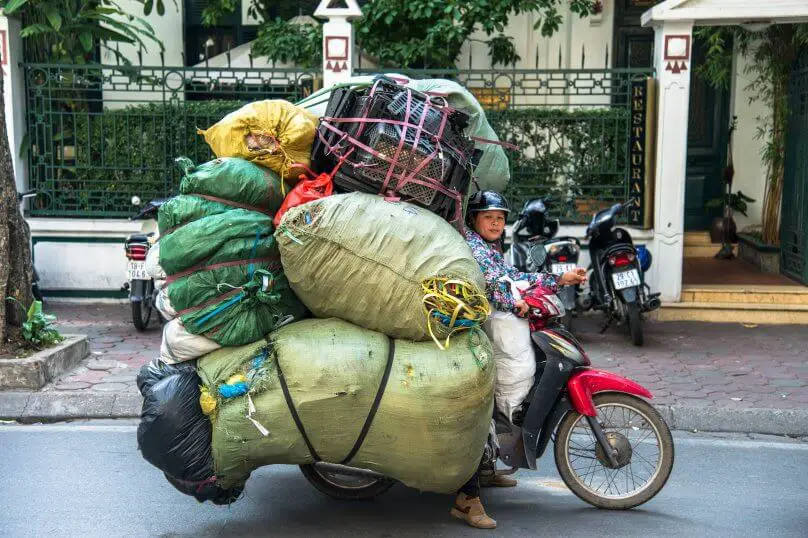
  • Do not carry too many objects on a motorbike.
  • In Vietnam, people drive on the right side of the road.
  • Look Out and Get Out of the Way for these following Vehicles or Situations: Fire trucks, military vehicles, police vehicles for emergency tasks, ambulance vehicles performing emergency tasks, or funeral caravans  Diving laws in Vietnam
 Drinking Age

In 2019, Vietnam still does not have specific regulations on what age you need to be to drink alcohol. However, in a new decree issued in 2017, the Government prohibits the behaviors of selling alcohol to customers under 18 years old.

This means that if you are at least 18 years old while travelling in Vietnam, you can legally drink and buy alcohol. Since the new decree only came out in 2017,  people younger than 18 are still able to find alcohol easily, but I always recommend obeying all Laws in Vietnam while traveling.

Vietnam Visa Laws

Is this the first time you have made a trip outside your own country? Vietnam is one of the destinations on your journey and you are still unfamiliar with the necessary documents for Entry and Exit? Well, this is what you need to know. If you are a professional traveler who has made countless cross-world flights, read on to make sure you don’t forget some small but important points.

What you need to enter into Vietnam without any disruptions is a Visa and a Passport. In case your country has signed a Unilateral Visa Exemption Agreement with Vietnam, make sure your Passport term is at least 6 months from expiration and your last Exit from Vietnam is at least 30 days before expiration. Airport staff will hold you back from going to Vietnam even if your Passport doesn’t expire for another 5 months and 29 days on the day you travel.

Up to now, Vietnam has been exempting Unilateral Visas for citizens of 13 countries including the Russian Federation, Japan, Korea, Norway, Finland, Denmark, Sweden, England, France, Germany, Spain, Italy, Belarus. These countries have been given a certain amount of time to travel in Vietnam without a Visa. Every country is different, so please check out our article filled with information about Vietnam Visas to learn more about your specific country and the Vietnam visa process.

On Exit through Vietnamese immigration you need a Passport, Certificate of Temporary Residence or Temporary Residence Card to leave Vietnam.
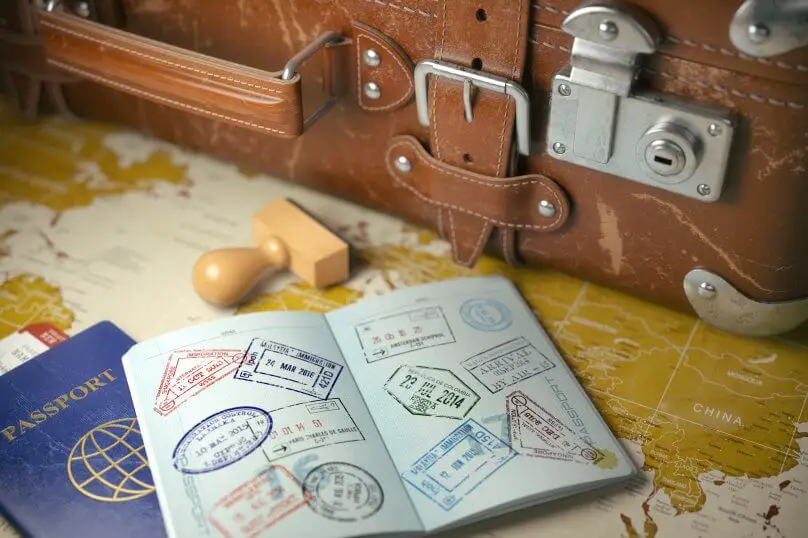
Passport and Visa are neccessary documents for entry in Vietnam

 Leave Your Porn at Home

Maybe you are quite surprised when reading this title, right? Vietnam’s Criminal Code has an article regulating penalties for spreading and disseminating unhealthy cultural products.

You can own newspapers and DVDs about sex, but keep it for yourself. Do not share it with others. Acts such as purchasing, storing, or transporting unhealthy cultural products aimed at distributing them to the public are considered criminal. If you have large amounts of pornographic materials in your luggage, Immigration may believe that you are trying to distribute these items. Ideally, you should not bring it with you on the trip to Vietnam. Another thing to note is that you shouldn’t discuss these topics in public, Vietanamese are conservative in general and do not appreciate inappropriate topics in public places.

You will have to pay a fine of between 10,000,000 VND ($431.97) and 100,000,000 VND ($4319.67) or imprisonment for 6 months to 3 years if you violate this law.

Be Careful What You Say about the Vietnamese National Symbols

In order to be an independent country, Vietnam has experienced over 1000 years of colonization by invading countries. Every Vietnamese person never forgets the names of heroes who have fallen for their freedom. That’s why they appreciate the peaceful life they are having and always respect national symbols. Any acts or words that are offensive to the National Flag, the National Emblem and the National Anthem will be considered as criminal. Therefore, be careful what you say about the national symbols. Don’t make jokes about it, it can bring you serious consequences.

Article 351 of the 2015 Criminal Code stipulates penalties for this intentional offense which includes warning or imprisonment of 6 months to 3 years.

Vietnamese national symbols

Gambling in Vietnam

Many people travel to certain destinations just for the thrill of gambling. They might be wondering about the question “Is Gambling in Vietnam Illegal?”. Well Yes and No, Gambling as a Vietnamese local with a Vietnamese passport is illegal in Vietnam. With that being said, foreigners can gamble if they have a passport issued from a different country. There are a few casinos in Vietnam that have been created just for tourists on holiday.

I will give you a list of six major Casinos in Vietnam and some Legal Rules needed to follow if you don’t want to incur a fine.

List of 6 Major Casinos in Vietnam

Do Son Casino: – Hai Phong City – Since 1995

The first casino allowed to operate in Vietnam

Ha Long Casino: – named Gaming Club – Since 2003


Ho Tram Strip Casino: – Ba Ria – Vung Tau- Since 2013

Belongs to The Grand Ho Tram Strip Tourist Resort

Casino of Aristo International Hotel: located in the center of Lao Cai city. Belongs to Donaco group (Australia)

Club Crowne International: located in Silver Shores International Resort on Bac My An beach (south of resort Furama) in Da Nang.

Start to operate on December 23, 2009

Phoenix Club Bac Ninh: located in Phuong Hoang International Resort & Recreation – Phoenix Resort Bac Ninh, is about a 45-minute drive from Hanoi City and Noi Bai International Airport.

What Conditions do I Need to Meet to be Allowed to Gamble at Casinos in Vietnam?

The following two conditions are required to enter into any Casino in Vietnam legally:

  1. Have a Foreign Issued Passport
  2. Minimum 18 years of age

**If you do not have your passport, you will not be allowed into a casino**

The Rules You Need to Follow

After the conditions to be allowed to gamble legally in Vietnam, you need to follow the rules below during the process of gambling at Casinos:

  • Bringing documents to prove that you have met the necessary conditions above(Bring your passport)
  • Comply with the Game Rules, Internal Rules, Regulations of the Relevant    Internal Management of Enterprise and Fulfill all Tax Obligations to the State
  • Do not use the results of prize-winning games at Casinos to bet directly with each other
  • Do not cause loss of security, social order, and safety at CasinosAre Casinos legal in Vietnam

Penalties for Violating The Rules

  • Warning for non-compliance with Game Rules, Casino rules, Internal Management Rules of Casino
  • A fine of between 20,000,000 VND ($863.93) and 30,000,000 VND ($1295.90) for acts of causing security, social order and safety at the Casino
  • A fine of between 90,000,000 VND ($3887.70) and 100,000,000 VND ($4319.67) for acts of fraud in the process of participating in prize-winning games at the Casino and being forced to return illegal profits 

If I find Antiques, Can I bring it back with me?

On your trip in Da Nang, Hoi An, or some places famous for its long history, if you’re super lucky, you may suddenly find an antique of 100 years old. Do you want to bring it home and display it in your living room? It will be very beautiful! But I have bad news for you, you are not allowed to bring those beautiful antiques out of Vietnam.

Law on Cultural Heritage stipulates that all antiques found in Vietnamese territory are owned by the public of Vietnam. What you have to do when you find an antique is to report it and hand it over to the competent state authority in the area nearest to you. As a reward for having found it, the Ministry of Culture will have a bonus for you. In situation, you really want to own or take it home, ask the state authority to know more information about the necessary conditions and procedures.
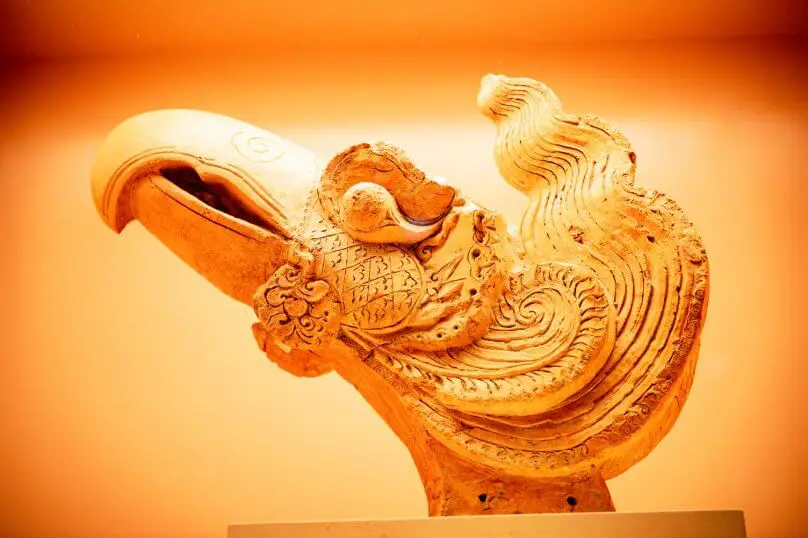
Is it legal to bring Antiques in Vietnam back with me?

What to Leave Behind in Vietnam

Flammable materials, explosives, knives, guns or other potentially injurious items are things you should not bring on your way out. Especially guns, it is illegal in Vietnam. You will even have to be sentenced to 7 years in prison if someone finds a gun in your bag (but I think it is very rare, no one wants to carry a gun on their vacation). Any potentially dangerous items will give you trouble if you are caught in possession with them.

I know what you are thinking? Why the hell would I have any of these things and try to leave Vietnam with them? Here is a small example of something that is innocent in nature and sometimes overlooked by travellers. I’m referring to the bullet casing from the AK 47 used at the Cu Chi Tunnels, many travellers would like to take this home as a souvenir but are stopped from leaving the country with it.

Things You are Not Allowed to Post on Social Media

“I have the right to post anything I want on social media. That’s my freedom.” On January 1, 2019, this statement is no longer true. That is the date when the Network Security Code came into effect in Vietnam. The government wants to make sure that people will use social media positively and avoid hurting anyone or national security issues. The following are the things you should be careful when posting them on social media in Vietnam:

  • History, Religion, Racism, and Sexismg
  • Issues related to Vietnam’s politics and social order
  • False information, statements that can offend other people’s honor and dignity
  • Acts to incite people to commit crimes and reactionary 

If You See Ladies of the Night Canvassing for Customers, Just Leave

Prostitution is absolutely illegal in Vietnam. Sometimes while walking on the road at night, you might see some ladies looking for customers. At some karaoke and bars, you may receive an invitation from the people trading in this type of service. What you need to do is say No and leave immediately. Vietnamese law prohibits acts related to prostitution. I will provide some legal information about prostitution to prove what I just said.

The act of sex between men and women or between people of the same sex for other material benefits is considered prostitution in Vietnam.

 Legal Provisions on Acts of Buying Sex

If committing acts of Buying Sex, both foreigners and locals suffer from the following sanctions:

  •  A fine of between 500,000 VND ($21.60) and 1,000,000 VND ($43.20) for acts of buying sex
  •  In case of buying sex with many people at the same time, they will be fined from 2,000,000 VND ($86.39) to 5,000,000 VND ($215.98)
  •  In case of enticing or coercing other people to buy sex, they shall be fined from 5,000,000 VND ($215.98) to 10,000,000 VND ($431.97)

Acts of Buying Sex with more aggravating circumstances such as buying sex for adolescents or knowing that they are infected with HIV and still deliberately spreading it to sex workers will be considered criminal and suffer penalties under the Vietnamese Criminal Code.

Drugs, Shisha, Funky Balls and more things you need to know

Vietnam and many countries in the world have listed drugs on their list of banned substances. According to the Criminal Code 2015, drugs include:

  •  Opium resin, marijuana resin or cocaine resin
  •  Heroine, cocaine, Methamphetamine, Amphetamine, MDMA
  •  Leaves, roots, stems, branches, flowers, marijuana fruit or coca leaves
  •  Dried poppy fruit and fresh opium fruit
  •  Other narcotic substances in solid and liquid form

All acts of buying, selling, storing or producing the things listed above will be treated as criminal and subject to severe penalties.

There are many other types of stimulants that are harmful to health but are not included in the cases mentioned above, specifically Funky Balls (Balloons) and Shisha. Since they are not Drugs, when you arrive in Vietnam, you can easily find many luxurious cafes, bars, karaoke and restaurants selling these two stimulants. Is It Illegal to Use Funky Balls and Shisha? I’m gonna go into the details of each one so you can get the answer to this question.

Is It Illegal to Huff Balloons?

Funky Balls are balloons pumped with gas. This gas is a chemical formula of N2O (Dinitrogen monoxide or nitrous oxide). When inhaling this gas, it can exert a strong impact on a point of the amusing nervous system to create a sense of euphoria for the user.

Currently, there is no specific law stipulating that the use of Funky Balls is illegal. But the use and sale of them is still dangerous.

– Funky Balls are harmful for the health of users. The regular use of N2O gas can cause disorders such as the stinging sensation in the head followed by staggering; chromatic disorders; memory disorders; sleep disorders; arrhythmias and hypotension; anemia and deficiency of B12. Prolonged use of N2O gas is not recommended.

How about Shisha?

Tobacco has been sold on the streets of Vietnam for many years, you can often see old men or women using this tobacco in long wooden pipes throughout Vietnam. Shisha Tobacco is still a bit new in Vietnam in comparison to our pipe tobacco. Shisha is tobacco leaves with added honey or fruit flavorings such as grapes, oranges, apples, and strawberries. This type of tobacco is not on the prohibited list. In the past, Shisha was only found in discos and bars so the recent popularity is new and lawmakers have not yet made a formal decree on Shisha smoking.

Shisha is not included in the group of drugs and is not included in the list of goods banned from business stipulated in Decree 59/2006/ND-CP. That’s why it’s not banned from selling. If meeting the conditions, people can still be licensed to trade in Shisha. However, this is also a commodity that is not supported by the state and may be restricted or banned in the future.

In conclusion, the current law does not have a specific law that prohibits the use of Shisha. On the other hand, you need to know that the state doesn’t encourage it. To handle the question “Is It Illegal to Use Shisha?” my answer is No. In my opinion, the government will not be creating regulation against Shisha use in the future.
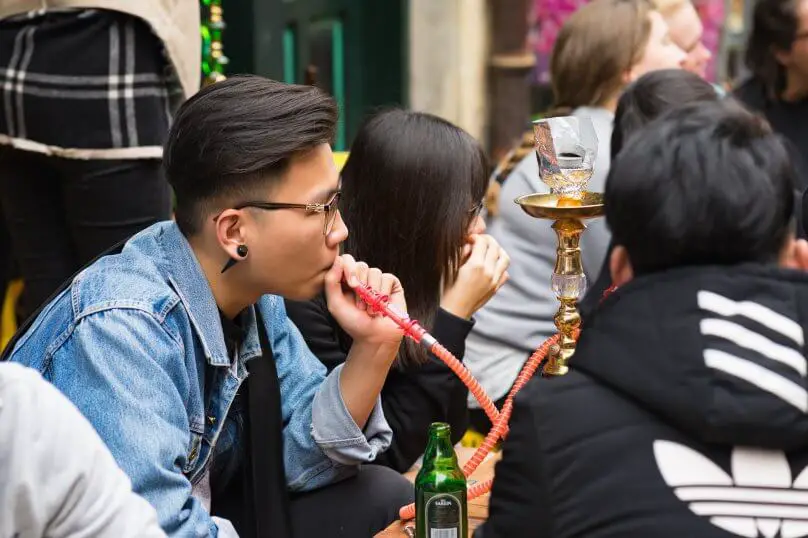
Is shisha legal in Vietnam

Source Here: What is illegal in Vietnam? Rules and Laws for Tourists
What to do in Can Tho? An Overnight Trip

So You’ve heard about the floating market in Can Tho as a must see in Southern Vietnam’s Mekong Delta, but your options to visit are endless. Should you take a full day or half day tour? Spend the night? Or relax in Can Tho city for a few days?

So you want to know, How many days should you stay in Can Tho? My recommendation is 2 days in Can Tho if you can spare the time in your itinerary. I believe that the floating market is only great if you visit very early in the morning, which will require you to stay overnight in Can Tho at least 1 day minimum. The rest of this article, I’m gonna lay out more information so you can better decide how many days in Can Tho is right for you.

Getting to know Can Tho

As a Ho Chi Minh City girl, when I visited Can Tho for my first time I thought that I would only want 1 day in the area to explore the famous market. After that visit, I found myself coming back 2 more times because I really loved the experience and warmth that I felt from the people in the Mekong. All of us Vietnamese know that people from the Southern parts of our country are hospitable, but you really don’t know until you experience it for yourself.

Can Tho is a great city because it’s unique compared to others in Vietnam. Located in the heart of the Mekong Delta, this city has become a must see destination for travelers in Southern Vietnam. While most other cities in the Mekong see barely 1 million visitors a year, the Mekong delta receives over 8 million a year. This cities popularity comes from the numerous canals and the river access that helped develop the famous floating market which has become a must see for travelers.

Can Tho is home to over 1.5 million local Vietnamese making it a large city. It takes only 4 hours from Ho Chi Minh City to get to Can Tho, which makes it an easy day trip for tourists. This prime location next to Ho Chi Minh City is the reason it has a big economy that supports its large population. The rivers and canals give access to local farmers to sell their goods and easily bring them to market in Can Tho before they finally make their way out to Ho Chi Minh City or the rest of the world.

Even though the city is large and bustling with trade, it’s easy to escape to the countryside of the Mekong Delta just outside of Can Tho. This area is dense jungle and farm land filled with traditional Vietnamese culture. Many visitors love to visit small homestays in the area to have some time away from the big city of Ho Chi Minh and experience the real charm of the Mekong Delta.

Full Day Tours to the Mekong

I know there are lots of people who choose to visit Can Tho for only a day trip. When you choose to only visit on a day trip, you miss most of the fun. The floating market should be the highlight of this trip but unfortunately, not many buses or travel agencies could get you there early enough in the morning. By the time you get to Can Tho, the market won’t be busy or worth the trip.

If it’s the first and maybe your only chance to visit Can Tho, then you’re in for something special. Don’t push yourself to the point of exhaustion to see everything in just one day. There are even some great tours out there that we recommend you check out, we put together this great list for you to choose from here.

What to do in Can Tho with 2 days?

To be honest, it would be a shame to travel all the way to Can Tho without taking a trip to Cai Rang Market. I don’t want you to look back on the trip with regrets or the feeling of missing out.

Make sure you can visit for at least 2 days in order to see the best of what the city has to offer. This way you can have more flexibility in your itinerary and avoid tiring yourself out.

Canal boats are popular transport link in Can Tho in order to visit other destinations such as the floating market and islets. It can be time-consuming because tourists will need to wait for the next boat to arrive. That’s why you should consider how much time you will need to travel between sites. If you choose a day trip, you won’t have enough time to see the city’s main highlights.

Organizing such a short trip to visit the city’s top attractions is tough. If you are seeking for some bits of advice on what to do in Can Tho, check out my itinerary below.

What to do on the First Day in Can Tho

Depending on when you arrive in Can Tho, you will have more or less time to visit places. If you arrive before noon, you may want to get yourself to Con Son islet right away.

Con Son

Con Son islet lies in the middle of the river, so to get there you need to take a boat from Co Bac wharf. It will take you only 5 minutes to arrive at Con Son.

This place is community based tourism where locals share their way of life. This allows the locals to support themselves and improve livelihoods  Around 10 families take part in tourism services, each family has different interests or activities to offer the tour experience.

On your first destination, you will have the opportunity to explore a tropical fruit garden. You are free to try all sorts of tropical fruits or buy some to eat later.

At the next destination, visitors will have the opportunity to learn how to make traditional cakes and learn how to fish.

After enjoying all the activities, you are welcome to stay for a homemade lunch. The locals will serve simple yet flavorful dishes such as canh chua, banh xeo, and banh lot.

It should take a whole afternoon for you to enjoy everything in Con Son.

Ninh Kieu Bridge

Then, let’s head back to the city of Can Tho and spend a nice evening here. After dinner, you can burn some calories by taking a walk on Ninh Kieu pedestrian bridge. This is the most photogenic place in Can Tho with 2 gigantic lotus flowers made of thousands of neon lights that brighten up the whole area. This is a great spot for taking pictures or just simply enjoying the great view of Can Tho at night.

Tay Do night market

Continue your visit of Can Tho by going to Tay Do night market, located right next to Ninh Kieu Bridge. Inside the market, there are many souvenir vendors, coffee shops and small restaurants.

If you want to discover this area a little more, you will easily find dozens of food stalls across the street, serving all kinds of delicious street foods. This could be an option for dinner treats if you would like to explore street food.

What to do on the Second Day in Can Tho

Floating Market

The whole reason for visiting Can Tho overnight is so that you can see the floating market super early the next morning. This means around 6 am you should be on your little boat going out to the see the vendors, this is when the market is really in full swing. The market will usually settle down by 8 am which is the time that day trips in Can Tho are leaving Ho Chi Minh City. It means that the market they see is only for the tourists benefit, it isn’t actually the real hustle and bustle of the early morning market.

On each boat, the owner will tie whatever they are selling to long poles that reach high above the boat so others can see what they are selling from far away. For example, if you want to buy some pomelos, look for a hanging pomelo and ask the boat to sail towards it.

The biggest attraction of the market must be the delicious food that is cooked and served right on the boat. There are lots and lots of tasty Vietnamese food for you to choose like Hu Tieu, Bun Bo, or Bun Rieu. There are a few drinks being commonly offered like iced coffee, coconut juice, and soy milk.

Once you finish your breakfast, you should take a tour around Mekong canals before leaving Can Tho. By the time the sun starts to heat up, your tour has come to an end.

Below are some of the tours that will help you go to the floating market in Can Tho

Vietsun tourist

  • 211/13 Nguyen Van Linh street, Hung Loi Ward, Ninh Kieu District
  • Hotline: 0939844234

Mekong delta explorer

  • 58 3/2 street, Xuan Khanh Ward, Ninh Kieu District
  • Hotline: 0932886008

Mekong smile tour

  • 46 Hai Ba Trung Street, Tan An Ward, Ninh Kieu District
  • Hotline: 0939729609

I hope my recommendations will be useful for you to enjoy a wonderful vacation without missing all the fun in this marvelous city in two days.

Original Post Here: What to do in Can Tho? An Overnight Trip

Where to Buy a Sim Card in Ho Chi Minh City?

A customer recently asked us “where can i buy a sim card in Ho Chi Minh City?”. We always do a lot of research when we get a question like this from a guest. We were actually really surprised to see that quite a few people had been taken advantage of by purchasing sim cards from random tourist kiosks in the airport.

If you are looking where you can buy a sim card in Ho Chi Minh City you should only purchase from reputable suppliers at their shops or kiosks. I recommend buying from Viettel or Mobiphone at their locations inside the city or their Kiosk inside the airport. These companies are the two biggest networks in Vietnam so you can have some of the best coverage available. Random shops or kiosks aren’t certified to give you a sim card, so avoid these suppliers at all costs.

Where to Buy a Sim Card in Tan Son Nhat Airport?

The whole reason for writing this blog article is to hopefully help a few people that are looking at buying their sim card inside of the airport before getting onto the street. After being on a long flight I know that most of us are ready to connect online and let everyone know that we arrived safe and sound to our destination. Also, it’s a comfortable feeling to be able to look up answers to questions you might have when trying to get to your accommodation.

It didn’t take very long when doing research on Sim Cards to see that so many people have been taken advantage of when buying a sim card in Tan Son Nhat airport. The biggest scam it seems is that sim cards that work for just a short amount of time and then are shut down after 7-8 hours.

This is why my piece of advice for getting a sim card is to ignore all of the other Kiosks except the official Viettel and Mobiphone Kiosks. These companies are the only recommendations I am going to make in this article. If there is another kiosk offering a sim card for a few dollars less, I personally wouldn’t even consider it. The headache of getting a sim card that stops working way before its supposed to isn’t worth it. 

If you are like myself and want to avoid any type of headache after a long flight to a new place you can order your simcard through Klook for or even While these sim cards don’t use my favorite providers, Vinaphone is still a popular and reliable service provider in vietnam.


Where are the Viettel and Mobiphone Sim Card Kiosks in Tan Son Nhat Airport?

These Kiosks are located after you get out of customs. That means you’ll have to wait until you go through immigration in order to get to the correct Kiosks. In our research we found that the biggest complaints about being ripped off happened at the kiosks before immigration so we highly recommend you avoid these options.

The Viettel and Mobiphone kiosks are located at the exit of the terminal after baggage claim. You’ll be able to see that their brand name is prominently shown on their Kiosk.

Where to buy a SIM card inside District 1, Ho Chi Minh City?

If you aren’t going to buy your sim card in the airport.  You can seek out the official Viettel and Mobifone stores. Viettel and Mobiphone have a few locations in District 1, we recommend making a trip to their stores to buy a sim card directly if you didn’t buy one in the airport.

Viettel

Address: 166 Tran Hung Dao

Hours: 8am-8pm

Mobifone

Address: 81b Nguyen Du, District 1 (near the Notre Dame Cathedral and Central Post Office)

Hours: 8am-10pm

These locations are always quite busy, so it could take a little while to be helped. You can rest assured though, if you buy your sim card from here it will be fully functional and official.

Which Sim Card should you buy?

I believe hands down the best network is gonna be Viettel. I have used mobiphone for my entire time in Vietnam, but looking at the coverage for both Viettel and Mobiphone it is easy to see which one has the superior network.

Viettel has much more 4g coverage spread across the areas of Vietnam.

Mobiphone’s coverage isn’t bad but their 4g network isn’t as large as Viettel.

What are the requirements to buy a sim card in Ho Chi Minh City?

In 2016, there was a crack down on agency enforcement to prevent the illegal sale of sim cards. This was due to issues with phone scammers and national security.

This means that all sim cards require an ID or Passport to be registered. If a sim card is sold without the request of your passport information, you can bet that this isn’t an official card or there is something fishy going on.

How much do Sim Cards cost in Ho Chi Minh City?

There are a few different plans available for tourist sim cards. You’ll have the option to choose just data if you don’t think you’ll need to make any phone calls during your trip in Vietnam.

The price range for a few Gigabytes of data will range from 200-300,000 VND.

Everyone’s phone usage differs but a few gigabytes of data should be good enough for a 2-3 week vacation in Vietnam.

Can I top up a Sim Card that I bought?

Topping up a sim card in Vietnam is extremely easy. You can buy a scratch off card for both Mobiphone and Viettel from most any small mom and pop shop and convenience store in Vietnam.

If you get a number from a convenience store it will come on a receipt instead of a scratch off. Type *100*, then your number on your scratch off or receipt, and then the # key. You’ll receive an sms from the carrier to let you know they received your top up.

We hope this information has helped you when you go to buy a proper sim card. Traveling around with a good connection to the internet is important in a country where you don’t speak the native language. Hopefully you have a great time in Vietnam with some full bars on your phone!

Source Here: Where to Buy a Sim Card in Ho Chi Minh City?

What to Wear to the Cu Chi Tunnels?

My first trip to the Cu Chi Tunnels actually came after I had already been living in Ho Chi Minh City for a few years. In all honesty, my friend and I were up pretty late the night before having some adult beverages out on the town. When 8 am came, it was time for us to meet our tour guide and open air jeep for a tour to the Cu Chi. I stumbled out of bed bleary eyed and still tired, I quickly grabbed some simple clothes out of my wardrobe, slipped my feet into my flip flops right before heading out the door. I wish I had thought ahead and prepared some better clothing options especially my shoes.

The Cu Chi Tunnels does not have a dress code, but I have learned the clothing you should wear would be a simple top or t-shirt, jeans or shorts, and sneakers. The clothes you bring for the cu chi tunnels should also be old. Everything you wear you shouldn’t mind if it gets dirty or sweaty, because it will. Do not bring a large bag for your trip as it will be difficult to bring through the tunnels.

What kind of Shirt to Wear to the Cu Chi Tunnels?

Super simple but something a bit dark that won’t stain up if you get it a bit dirty. You don’t want to wear your brand new or favorite shirt on this day trip from Ho Chi Minh. As you pass through the underbrush of the jungle you’ll be brushing up against mother nature which could leave some dirt and stain marks. Even more obvious though, is when climbing through the tunnels you are gonna bump up against dirty walls that are gonna make you a bit messy.

If you did bring a small bag, I would consider keeping an extra t-shirt to change into on your way back home so that you aren’t as dirty and smelly during the 2 hour trip back to Saigon.

Why wear pants or jeans to the cu chi tunnels?

After living in Vietnam for such a long time, I have learned the valuable lesson of wearing pants or jeans even when the weather is hot. If you looked at most photos of Vietnam you would see that everyone is wearing clothes that cover large parts of their arms and legs. This isn’t out of a shyness about showing off skin, but rather to keep skin out of the sun.

This lesson can be applied to running around at the Cu Chi Tunnels, some pants or jeans are gonna help keep bugs and sun off of your skin. It will also be a bit gentler on the knees if you crawl through the tunnels. Hopefully you brought a pair of pants that you can use on some adventure tours on your trip to Vietnam.

Won’t my jeans get ruined if I wear them crawling around the tunnels?

I wouldn’t worry too much about that if you’re not going to rough through the tunnels when on your hands and knees. Just take it easy, what will happen is your gonna get a little dirt on your jeans but if you aren’t cruising like a toddler who has mastered crawling, everything should be just fine!

Does that mean I shouldn’t wear shorts?

No, not at all. It’s just a suggestion since you will be crawling on your hands and knees. Jungle foliage will brush up against you a little bit here and there. Also, some of us are more susceptible to being bit and bothered by bugs than others.

If you love shorts, which I personally wear 95% of the time, then go ahead and rock some shorts when you visit the Cu Chi. I would just recommend not wearing Basketball shorts that are loose fitting as it seems a bit easier for bugs to get into or dirt to find crevices to fall into. When I wore a pair of gym shorts on my first visit, I honestly just felt like they were gonna come off as I was crawling around the tunnels, so I wouldn’t suggest them.

How about wearing sandals or flip flops to the Cu Chi Tunnels?

Sandals were my first choice when I made the trip the Cu Chi with my friend. She had a solid laugh a few times on the trip while walking around the jungle foliage I was slipping around. We had a little bit of rain that day which made everything a slip and slide for my no grip sandals.

I just kept picturing me slipping on some of the loose dirt and leaves to find my backend sitting in a muddy puddle. That would have been a fun ride home! So, my recommendation is to put on a pair of sneakers or slip on shoes to avoid any of the issues I had. It’s a fun day of hanging out in the underbrush of the jungle outside of Ho Chi Minh City, better to dress the part from head to toe.

What to Wear to the Cu Chi Tunnels if you think it’s gonna rain?

This is probably gonna happen if you are visiting Southern Vietnam in between May and Early December.  If you aren’t sure about the weather in Vietnam, you can read up about it at our best time to visit Vietnam weather article.

Honestly, I think if you are following this guide, I would wear exactly the same things recommended above. Here is a little trick for you though as someone who has been around Vietnam for a while. If you wanted to bring a smallish backpack that you only put sandals in, this would be great for you to store your wet shoes and socks in while you slip your sandals on during the trip back to Ho Chi Minh City.

What else Should I Pack into my Bag for the Cu Chi Tunnels?

Be careful when bringing a bag to the Cu Chi Tunnels because you are gonna have to carry the bag through the tunnels with you. Packing some bug spray would be a great idea as there are a lot of insects in the Cu Chi area. Last but not least, be sure to pack some suntan lotion for the trip. Taking care of your skin will be important no matter where you are visiting in Vietnam.

Read More Here: What to Wear to the Cu Chi Tunnels?

5 Must Eat Vietnamese Street Food Snacks You Don’t Want To Miss On Your Trip To Saigon


Vietnamese Jicama Roll, Bò Bía

The little brother of the infamous Vietnamese Spring Roll a.k.a Goi Cuon, Bo Bia is one of the easiest snacks to find when walking down the street of Ho Chi Minh City. This spring roll packs a unique punch of flavor and texture in comparison. With rice paper on the outside, Jicama, Beef Sausage, Dried Shrimp, fried egg, fried shallots, and multiple herbs on the inside this little roll is not to be missed.

You can find this served with a peanut dipping sauce, don’t forget to add the chili for that added heat.

Vietnamese Rice Paper Salad with Dried Beef, Bánh Tráng Trộn

The question “What is your favorite Vietnamese Food?” is a staple during our Interview process at Back of the Bike Tours. Eighty percent of the time I am given the quick and enthusiastic answer of, “Banh Trang Tron!”

Like so many other dishes in culinary history, this dish started out just trying to solve a problem. What to do with all of that scrap rice paper? Well, make a salad out of it! Using thin strips of rice paper to compose the bulk of the salad, Dried beef, Dried Shrimp, Quail egg, Vietnamese Hot Mint, Julienned Green Mango, toasted peanuts, and fried shallots are tossed together with a loose, dark, sweetened soy sauce with kumquat juice.

After being thoroughly mixed, it’s tossed into a bag with disposable chop sticks shoved inside.

This concoction is a fun texture experience and bursting with a great combination of flavors. This dish is great for accenting the strong and unique flavor of Vietnamese Dried Beef.

Quail fried in Butter, Cút Chiên Bơ

It’s not difficult to miss the man on the street corner with a rotisserie over open flames. What might be difficult to miss is the small birds that are strung through the poles roasting over the flame. Every few minutes, the quail vendor, will brush these little birdies with his own oil or butter mixture that will usually contain a dried herb and spices to add a unique flavor to each vendors quail.

These quail can be taken to a whole another level when they are deep fried in sweet butter and served with a baguette. Fried Quail will normally come with pickles, Vietnamese Hot Mint, and Cucumber as an accompaniment to the dish.

Some might be grossed out by the serving of the quail head still attached to the neck. No worries, it has a great pop to it when you take it in one bite.

Pork and Pork Sausage Skewers, Heo Nướng – Hồ Lô Nướng


Grilled pork over an open fire! Count me in! These meat skewers are a great pre-game to hold you over before dinner.

Heo Nuong, Marinated Pork Skewers, find an excellent balance between chewy and tender. Pork comes into the markets around 4 AM here in Saigon. That is when the pork shoulder is purchased, then cut, and marinated for 6-8 hours in a mixture of honey and sesame seeds.

Holo Nuong, Sweet Pork Sausage balls, can’t help but leave a smile on your face when your teeth pop the roasted casing on the outside to find yourself enjoying a great balance of fat and sugar that is mixed into the sausage. Named for its resemblance of a round squash, these sweet morsels of meat are typically found in Southern Vietnam.

Don’t miss the chili sauce and pickles that are necessity in balancing out the rich meaty flavor. Also, a nice cold beer goes quite well.

Grilled Vietnamese Rice Paper, Banh Tráng Nướng

Hailing from the mountain area of Dalat and one of the newest to arrive in the food scene of Ho Chi Minh City, Banh Trang Nuong, has been dubbed the “Vietnamese Pizza”. Here are the basics for almost every Banh Tranh Nuong, Rice paper, open flame, egg, and cheese. Top this with anything from Dried beef, green onions, spicy chicken, or even take the desert approach and try some banana. This crispy snack is being served in little restaurants or right on the street so it isn’t hard to miss.

If you are interested in then be sure to check out our, if you are looking to check out a specific food in vietnam then ask about our private tours and chefs tours!

Learn More Here: 5 Must Eat Vietnamese Street Food Snacks You Don’t Want To Miss On Your Trip To Saigon

The Best Boutique Hotels in Ho Chi Minh City

While it is quite easy for anyone to look up on TripAdvisor or Agoda for the best hotels in Saigon (and get some great deals), we have decided this time to search some accommodations here that stands out (to us) for their decor and style. As always, this is purely based on our team’s opinion and this is not a sponsored post by any of the hotels mentioned below. Check out the video for the best boutique hotels here and scroll down for the list of addresses:

If you enjoy this feel free to check out more about our articles on Where to stay in Ho Chi Minh City.

Our Best Boutique Hotels:

#5 L’Odeon, 63-65, Lê Văn Thiêm Street, District 7

#4 Town House 50, 50 Bùi Thị Xuân, Bến Thành District

#3 Cinnamon Hotel Saigon, 74 Lê Thị Riêng, Bến Thành District

#2 The Alcove, 133A Nguyễn Đình Chính, Phú Nhuận District

#1 I Am Vietnam, 30/57B Nguyen Cuu Van Street, Bình Thạnh District.

Are you planning to stay at one of these boutique Hotels in HCMC? Which one did you choose?

Originally Published Here: The Best Boutique Hotels in Ho Chi Minh City

Staying in Ho Chi Minh City District 4 : Tips for Air Bnb Guests

Let’s face it, during your first tip to Saigon, You don’t know anything about the different districts of Ho Chi Minh City. Now it’s up to you to pick the best spot for your family to stay during your vacation to Ho Chi Minh City! The pressure is on! I’m gonna give you some information about District 4 compared to District 1 to help you make a decision if an Air Bnb in District 4 is a good option for your family.

How does Ho Chi Minh City’s District 4 compare to District 1? They are very different but District 4 is so close to District 1 that it makes sense to stay here if you are travelling. I’m going to go over some of the questions you might have if you choose to stay in District 4 rather than District 1.

Should I stay in D4 instead of D1?

This all depends on what you are looking for. In my opinion, if you are planning to spend most of your time outside of your hotel, I would have no problem staying at one of the accommodation options in District 4. It is an easy hop in a taxi cab to get right into the thick of things in the middle of District 1.

If you are looking for an apartment style stay that has a swimming pool, the accommodation options in D4 are pretty sound. The location is good if you are okay with jumping in a taxi cab ride when you want to go out. If you decide to walk around, you’ll be in for a real experience of a local area of Ho Chi Minh City. Honestly, this isn’t the right location to stay in if you want to leave your hotel and walk right outside to find a restaurant that is suitable for younger kids or western food.

District 4 Information

Over Thirty years ago, district 4 was often known for its low level of security and gangsters. However, thanks to improving management by government and gentrification, today District 4 is a pleasant place. It hasn’t been known as a dangerous area since the 70’s.

Due to its location, District 4 has become a coveted area for people to live and work. This makes the property value for homes in District 4 extremely high. Many of the families who still live in this district now have been living in these houses for decades. The small houses that we refer to as tube houses because of their narrow width but tall height are tightly packed in, creating a web of small alleyways that are very interesting.

In recent years, due to the influence of other nearby districts like District 1 and District 2, District 4 has gradually developed. Many new apartments were built here, streets were improved and repaired, entertainment areas also began to appear. This not only makes local people’s lives better but also creates convenience and comfort for tourists when visiting District 4.

District 4 Location Compared to District 1

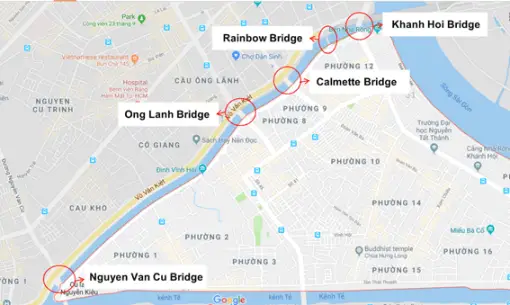
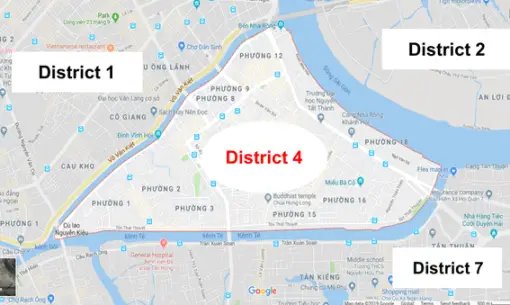
District 4 is likened to a triangular island located in the heart of Ho Chi Minh City. It is surrounded by rivers and canals and stuck among 3 other developed districts: District 1 (in the Northwest), District 7 (in the Northeast) and District 2 (in the South).

Map of District 4 and surrounding area


This means that District 4 is very close to District 1, people here usually only take 10 minutes to reach famous places in District 1. To get to District 1 from District 4, you need to cross a Ben Nghe canal. There are 5 bridges built to cross this canal such as Khanh Hoi bridge, Calmette bridge, Ong Lanh bridge, Rainbow bridge, and Nguyen Van Cu bridge. Depending on your location, you can choose the closest bridge to shorten the time to reach District 1.

District 4 Bridges connecting to District 1


Hotels or Airbnb?

Honestly, District 4 doesn’t have many hotels like District 1. So sometimes on holiday, hotels in District 4 often run out of rooms. Therefore, if you want to stay at a hotel to enjoy high-class service, you should book a room advanced.

Although not owning many famous hotels like District 1, however, District 4 has a lot of room rental services which local people open by themselves. To be able to find out more information about these rental rooms, you can easily find it on Airbnb’s website.

Normally, both hotels and room rental services will be in the newly constructed apartments right across from the canal. This means you are very close to the center of the city for a bit cheaper price. The area to wander about from these large apartments is actually interesting. Just behind these large apartments you can wander into Xom Chieu market for a visit during the day to see one of the most local and busiest wet markets in Ho Chi Minh City.

If you decide to take a look at some hotels in town check out our article about Hotels for Value in Ho Chi Minh City.

Transportation in District 4

District 1’s location for walking to some of the main attractions in Ho Chi Minh City is better than District 4. District 4 is about a 10-minute walk plus a bridge crossing in order to get to Nguyen Hue walking street in the center of the city. The walk might be a little bit difficult but interesting. While walking across these bridges, you can watch the canal flowing through the city and take some nice photos. The bridges at night will shine by the beautiful street lights, which is one of the typical beauties of this city.

If you are going for a night out and a bit dressed up, you’ll probably want to call a taxi or grab to give you a lift. I don’t think District 4’s location is convenient for making a lot of trips back and forth to the city center on foot but its very close if you are using a taxi cab. Check out our in depth article about about taxi cabs in Ho Chi Minh City to

Another thing about transportation in District 4 you should know is heavy traffic jams at rush hour. Because the roads in District 4 are quite small and narrow, so during peak hours these roads often occur more serious traffic jams than other districts. My university is located in District 4, every afternoon after school, it takes me about 45 minutes to 1 hour to get home. If you choose to use a taxi or grab to take you around, don’t choose rush hours to go out.

Walking around District 4

If district 1 is famous for high-class and luxury restaurants, the cuisine of district 4 is famous for being found in plenty with delicious options. There are so many people living, working, and visiting District 4 that the local street food is fantastic and famous. You can find street foods in food carts, food stalls or small private restaurants open by locals.  Food stalls and restaurants are usually located along many streets in District 4, which makes district 4 is so famous for many food streets. The three most famous food streets that I want to recommend to you are Xom Chieu, Vinh Khanh and Ton Dan.

Xom Chieu has special and delicious dishes. The food stalls and restaurants in this street have existed for a long time and have created a famous reputation. That makes them attract many people coming and trying the taste of special foods. These dishes which are cooked with unique recipes seem to be “specialties” of this district. Some “specialties” on Xom Chieu street I want you to know are banana cooked with sugar, crab soup mixed vegetables and many other types of ingredients, mussel noodles.

– Pha Lau Miss Oanh

Beef Organs Cooked in Coconut Milk served with Banh MI

Address: C200 / 20 Xom Chieu, District 4

– Vermicelli crab and snail

Address: C200 / 6 Xom Chieu, District 4

– Oc To

Small but Popular Seafood Stand

Address: C218 Xom Chieu, District 4

– Crab Soup Hang

Thick Soup made with Tapioca, Crab, Shrimp, and about 8 other ingredients

Address: C200 / 18 Xom Chieu, District 4

– Banana cooked with Sugar

Braised with sugar and topped with sesame seeds, this dish is unique to Xom Chieu

Address: Head of the alley 200 Xom Chieu, District 4

In 2018, Vinh Khanh street officially became the food street of District 4 and is strictly managed on food safety and hygiene by the government. Up to now, it has been extremely famous not only to locals but also for foreign visitors. Most of the restaurants here serve seafood and beer. Plates of seafood here are cooked in Vietnamese-style but a little bit spicier than normal Vietnamese food. Famous dishes like snails cooked with coconut milk, fried crab with salt and chili, grilled octopus with sate can be found up and down Vinh Khanh Street. If you are a person who loves seafood, Vinh Khanh is definitely a great choice for you. The operating hours of Vinh Khanh street are from afternoon to evening. The restaurants here are crowded at 6:00 pm until Midnight. Make sure that you are there at the right time so you can enjoy the bustling atmosphere of this food street and delicious dishes. If you want to experience street food like this but are a bit nervous to do it yourself,

– Chilli hotpot

Alot of grilled meat options, oysters, and hotpot. Delcious and Highly recommended

Address: 232 Vinh Khanh, District 4

– Oc Oanh

A standout on a street known for seafood, don’t miss out on the scallops!

Address: 534 Vinh Khanh, District 4

– Sushi Ko

International Sushi on the Street?

Address: 122/37/15 Vinh Khanh, District 4

In addition, other roads like Hoang Dieu, Doan Van Bo, Ngo Van So or Nguyen Truong To also have a few interesting restaurants. These roads are very close to Vinh Khanh and Ton Dan, you can visit them conveniently.

– Mi Vit Tiem Thuan Hieu

Chinese inspired Duck soup with wheat Noodles. Very Tasty and Open late

Address: 3 Hoang Dieu, District 4

– Crab Curry in Quan Oc 63

Crab smothered in Delcious curry sauce that you mop up with Vietnamse Bread. Very close to Air BnB’s on Ben Van Do

Address: 63 Nguyen Truong To, District 4

Any other recommendations?

Yeah, I’m gonna let you now about my secret coffee shop that is my absolute favorite This is my place for working during the afternoon. This is located 2-5 minutes from the Air BnB locations in District 4.

Spotlight Coffee 

Address: 64 Le Quoc Hung, Ward 12, District 4, Ho Chi Minh City

The operating hours: 7:00 am – 9:00 pm

We hope these tips help you make a decision on staying in District 4 or not. If so, please enjoy our recommendations for spending time in District 4 and commuting to District 1. Please share this article if you think it will help other travelers like yourself book a vacation that they will remember for a lifetime.

Source Here: Staying in Ho Chi Minh City District 4 : Tips for Air Bnb Guests

How to Take a Taxi in Ho Chi Minh City

Ho Chi Minh City is known for crazy traffic! There are viral videos and photos all over the internet that show the chaotic dance of traffic happening here everyday. Walking across the street in Ho Chi Minh City seems intimidating to some travelers. Never fear the taxi cab is here!

As a person who has been living in this city for years, I would recommend calling Mai Linh Taxi (028) 38 38 38 38, VinaSun Taxi (028) 38 27 27 27 , or booking via the Grab application. This post is a complete guide to traveling with taxis happily and safely in Ho Chi Minh City. I’ve crafted all you need to know about what brands to use and how to contact them.

What Taxi Brand should I ride with in Ho Chi Minh City?

When visiting Ho Chi Minh City, you should only ride in Mai Linh and Vinasun Taxi Cabs. They are the oldest and most trustworthy brands in Vietnam. If you are still nervous about riding a taxi cab there are alternatives digital brands for you to choose. Go with Grab or Goviet. These are popular brands here that are used daily.

Here are my useful tips for you to recognize these brands, how to book a taxi, how to reach customer service, and what to do if you lost something in your taxi. I’ll also guide you how to get a proper and trustworthy taxi when you first land in the airport.

Mai Linh

This taxi is hard to miss, it’s a distinct green color. The green color represents pure environment and brings some sense of comfort. This brand is familiar to not only local people but also many tourists as this brand can be found all over Vietnam.

Drivers of Mai Linh wear a white shirt, black trousers, and a green tie. These uniforms are really recognizable because of the green tie. If the taxi driver isn’t wearing this uniform, I would be suspicious and wait for a different cab.

Below we have listed all of the contact information for Mai Linh. It’s a good idea to keep their customer service number on your phone just in case you want to call them because of issues.

To Book a Taxi Call: (028) 38 38 38 38

The operators speak limited English. We recommend asking for the help of your hotel concierge or a friendly local if you need to call for a taxi.

Mai Linh’s Customer Service

Address: 64-68, Hai Ba Trung, Ben Nghe, District 1, Ho Chi Minh City, Vietnam

Hotline (Southern area of Vietnam): 028 3827 7979

Website:

Mai Linh does have an application but unfortunately there are too many errors making it not very useful. We recommend just grabbing a cab on the street or booking through the phone.

Vinasun

This is probably the most popular taxi cab in Vietnam. Their car is bare white with green and red lines connecting the wheels. The logo is a circle formed by red and green arrows, which reminds me of yin and yang symbol.

Similar to Mai Linh, the Vinasun taxi drivers’ uniform are white shirt, black trousers, and red tie. There is also a logo of Vinasun on the tie.

Phone number: (028) 38 27 27 27

This number speaks better English than Mai Linh. If you need to call on your own we recommend reaching out to Vinasun.

Contact of customer service departments:

Add: Vinasun Tower – 648, Nguyen Trai, Ward 11, District 5, Ho Chi Minh City, Vietnam

Tel:  (84-8) 38 277 178

Contact address when you lost your luggage: thatlachanhly@vinasuntaxi.com

When you want to complain about their staff: thaidophucvu@vinasuntaxi.com

When you have any other concern: contact@vinasuntaxi.com

Website:

These taxis are not only available in Ho Chi Minh City but also all cities in Vietnam. If you want to travel in Danang, Hanoi, or Hue City, remember the phone numbers and do those same steps.

Grab / Goviet

I may not have to tell you much about these brands. Grab is now the cheapest mode of transportation in Vietnam. Just download the app, install it on your phone. Then whenever you want a ride, open it and pick your means of transportation. You can choose your transportation between motorbike and car.

Older articles may say that Grab and Uber are two digital taxi brands in Vietnam, but you should take note that Uber has been shut down in this country since 2018. Moving into take the place of Uber, Goviet has become a popular ride app in Vietnam. Go Viet only has motorbikes at the moment, so if you have luggage, then stick to Grab.

How to get a taxi from Tan Son Nhat Airport in Ho Chi Minh City

There are two airports you can come in at in Ho Chi minh City. Getting a taxi from either airport is going to be very similar but a little bit different. We are going to direct you to make your way towards the “Taxi Queue”. At both airports you are going to need to make your way past the scammers and fake taxi’s looking to rip you off. These guys are gonna use the word “friend” alot and “looking for taxi”. Be strong but nice, and just keep moving away from them to find the queue.

At the international airport the queue should be across the little street when you exit from the terminals ground floor. The domestic airport you should make a left after exiting the terminal.

We only recommend two taxi services which we discuss in detail below. You are going to be looking for the representatives of these taxi companies so that you can get them to put you into the correct cab. The company’s colors is what you will be looking for to recognize their representative along with the brand logo.

Traveling from the Airport to the Center of Ho Chi Minh City

It takes around 30-40 minutes driving from Tan Son Nhat Airport to District 1, and even longer in rush hour. The cost for a taxi driving from Tan Son Nhat Airport to District 1 is around 100,000 VND to 200,000 VND (about 4.5 to 8.5 USD). Before leaving the airport, be sure to exchange some money as in Vietnam we only use our local currency.

How to Hail a Taxi in Ho Chi Minh City

Walking in Ho Chi Minh City is not popular, as the sidewalk infrastructure here is a mess. It can be an intimidating experience when you try to walk in this city. No worries, the taxis are here to help you get around.

Hail a taxi using our tips so that you travel safely in Ho Chi Minh City.

Lucky for everyone, there are usually taxi’s everywhere in Ho Chi Minh City. Specifically talking about the two brands we have mentioned above. It won’t take long to get a taxi if you stand on the street waving one down for a ride. The exception to this rule is during rain and rush hour. When hailing a taxi at these times, you can expect to wait if you don’t get lucky in the first few minutes.

Raise your hand to get the taxi driver’s attention. While they may understand your signal, you don’t have to yell “Taxi!” or whistle like in Western culture. If you can whistle loudly, I recommend you do that because you will just look cool.

When the taxi driver arrives, the next step is just telling them your destination.

Though drivers these days are trained to speak English, there are still elderly drivers who don’t. Thus, you’ll need to carry a phone with you to show them the address, or write down the address on a piece of paper. A screenshot of the location is also very helpful.

What do you do when lost your wallet/luggage/phone on the taxi?

First, contact the taxi customer service immediately and report what you’ve lost. Before calling, you should make sure that you can provide as much information as possible, including the taxi identification number, driver’s name, departure and arrival points, total fare, and the route that was taken.

If you forget your phone, you shouldn’t call your number. In case there are some drivers or passengers who may want to keep it for themselves. Instead, allow the operator to find the taxi you’ve taken and have it sent back to the office.

To conclude, traveling via taxis in Vietnam is easy. Follow these instructions, you have the best chance to enjoy your trip without being a victim of any fake taxis or scams. Just like in life, nothing is a guarantee but we believe that this advice will help every traveler in Vietnam.

Learn More Here: How to Take a Taxi in Ho Chi Minh City

How to Call a Taxi in Vietnam?

A Simple Guide for Taxi-hailing in Viet Nam

Taking a Taxi has never been a budget-friendly option for traveling around. The situation is the same in Viet Nam. However, it turns out to be a decent choice in Vietnam where the condition of the public transportation system is troublesome even in major cities. If you prefer walking to taking a vehicle, you may want to think again. The hot and humid atmosphere combined with the hustle and bustle of Viet Nam will tire you down.


If this is your first time visiting Viet Nam, there is a big chance that you have many questions about taxi services. You may not know how to appropriately hail a taxi and wonder if the cab you are trying to catch is licensed. You are afraid of being ripped off. You want to know if it’s possible to pay for your ride by credit/debit card. So, let us show you everything you need to know about calling a taxi in Viet Nam, especially in major cities.


We only recommend Mai Linh Taxi and Vinasun Taxi for foreigners in Viet Nam. If you have any doubt about traditional taxi services in Viet Nam, it may be a good idea to use ride-hailing apps such as Grab or GoViet.

How to Identify a Licensed Taxi?

Unlike some other places around the world, for example in New York where taxis are either yellow or green, there are many brands operating cab services in Viet Nam. Hence, there are more than just one or two uniform colors for taxis.

If the taxi you are ordering is not licensed, which means it’s illegal and unregulated by local laws, you can easily get ripped off. The authorities might not be able to help you in these scenarios.

According to laws applied to transportation service vehicles, these are the things you need to notice before getting on any taxi in Viet Nam to avoid falling into dangerous situations:

– Brand name, operating phone number, and logo of the taxi service provider on both sides of the car.

– A price chart, a working meter connected to a receipt printer, and a taxi driver’s name card on prominent display inside of the vehicle.

– An authorized taxi emblem stuck to the windshield.

– A light box that says “TAXI” standing on top of the car.

How to Know if a Taxi on the Street is Available?

If there is no passenger in the taxi between 6 PM to 6 AM, the driver is obligated to turn the lightbox on top of his vehicle on. If the light inside a cab is on, it’s available. You can feel free to hail them.

It might be frustrating to hail a taxi that looks “available” just to watch it pass by instead of stopping and picking you up. Perhaps the street is too crowded that the driver cannot turn the car towards you or they forgot to turn off the light. Please be patient and don’t get mad because it won’t happen regularly.

How to Order a Taxi in Viet Nam?

If you see an available licensed taxi on the street and want to hail it, feel free to do so since there is no specific spot for cab standing in Viet Nam. We know that hailing a taxi in the streets of Viet Nam doesn’t always bring about your desired result. Ordering one from their operators via phone might be a better option.

If you are staying in a motel, hotel or resort, ask the receptionist to order a taxi if you need one. They definitely can help overcome any language barrier.

If you want to order a taxi via phone by yourself, here is a list of the numbers of two trustworthy service providers in famous tourist cities and provinces of Viet Nam:

CITY/PROVINCE SERVICE PROVIDER PHONE NUMBER FARE (10% VAT INCLUDED)
Sapa (Lao Cai) Mai Linh Taxi 1055 (national)

(0214) 376 76 76

(0214) 370 70 70

Up to 20.600VND/km
Ha Noi Mai Linh Taxi 1055 (national)

(024) 38 333 333 (024) 38 222 666 (024) 38 222 555 (024) 38 616 161

Up to 20.600VND/km
Hoi An Mai Linh Taxi 1055 (national)

(0510) 3 92 92 92

Up to 20.600VND/km
Vinasun (0511) 3 68 68 68 Up to 16.500VND/km
Da Nang Mai Linh Taxi 1055 (national)

(0236) 3 56 56 56

Up to 20.600VND/km
Vinasun (0236) 3 68 68 68 Up to 16.500VND/km
Hue Mai Linh Taxi 1055 (national)

(0234) 3 89 89 89

(0234) 3 82 47 47

Up to 20.600VND/km
Nha Trang Mai Linh Taxi 1055 (national)

(0258) 38 38 38 38

Up to 20.600VND/km
Vinasun (0258) 38 27 27 27 Up to 16.500VND/km
Da Lat Mai Linh Taxi 1055 (national)

(0263) 38 38 38 38

Up to 20.600VND/km
Ho Chi Minh City Mai Linh Taxi 1055 (national)

(028) 38 38 38 38

Up to 20.600VND/km
Vinasun (028) 38 27 27 27 Up to 16.000VND/km
Can Tho Mai Linh Taxi 1055 (national)

(0292) 3 65 65 65

Up to 20.600VND/km
Vinasun (0292) 38 27 27 27 Up to 16.500VND/km

The meter begins counting when the taxi picks you up. There is a fare called “open-door-fare”. It is set approximately from 8.000VND to 15.000VND depends on the service provider and model of the car. The further your distance is, the cheaper fare-per-kilometer you have to pay. For example, Vinasun’s open-door-fare for a 5-seated Toyota Vios is 11.000VND. Then, you are charged 14.500VND/km for the first 30 kilometers, and 11.600VND/km from the 31st kilometer and beyond. There is always a price chart inside every taxi showing detailed information and fare.

There is no Uber or Lyft in Viet Nam. Instead, there are several similar ridesharing and ride service hailing networks such as Grab or GoViet for you to choose in your personal preference. They have foreseeable service fare as well as emergency reporting features thus the rides are more reasonable and safer.

How can you Pay for a Cab Ride in Viet Nam?

Drivers usually prefer cash. You can pay for your ride with credit/debit cards as well. Tipping is not a familiar manner in Viet Nam, but you can consider doing that if your trip is excellent. Drivers sometimes expect not to give back your change if it’s a small amount. If you feel irritated about it, tell them immediately.

Always Remember to Stay Aware

Before getting on any taxi, remember the number on the license plate, the taxi number glued on the windshield, or the driver’s name. If possible, take note of that information in case something dangerous happens. If you have a terrible ride or accidentally forget your belongings in the cab, providing that information to the operators can help solve your problems quickly.

You can’t fully trust registered drivers since some of them might try to rip you off by going on a detour. You could always open up Google Maps to make sure your driver isn’t taking you the long way.

Taking a Taxi is almost never going to be the most budget-friendly option. If budget isn’t your primary concern, taking a cab surely is easier and more comfortable than waiting for a bus or walking under the scorching sun. Also Taxi’s in Vietnam are most likely a lot cheaper than what you can find in other countries. We hope this article has helped you answer any questions you might have about how to call a taxi in Vietnam.

Learn More Here: How to Call a Taxi in Vietnam?